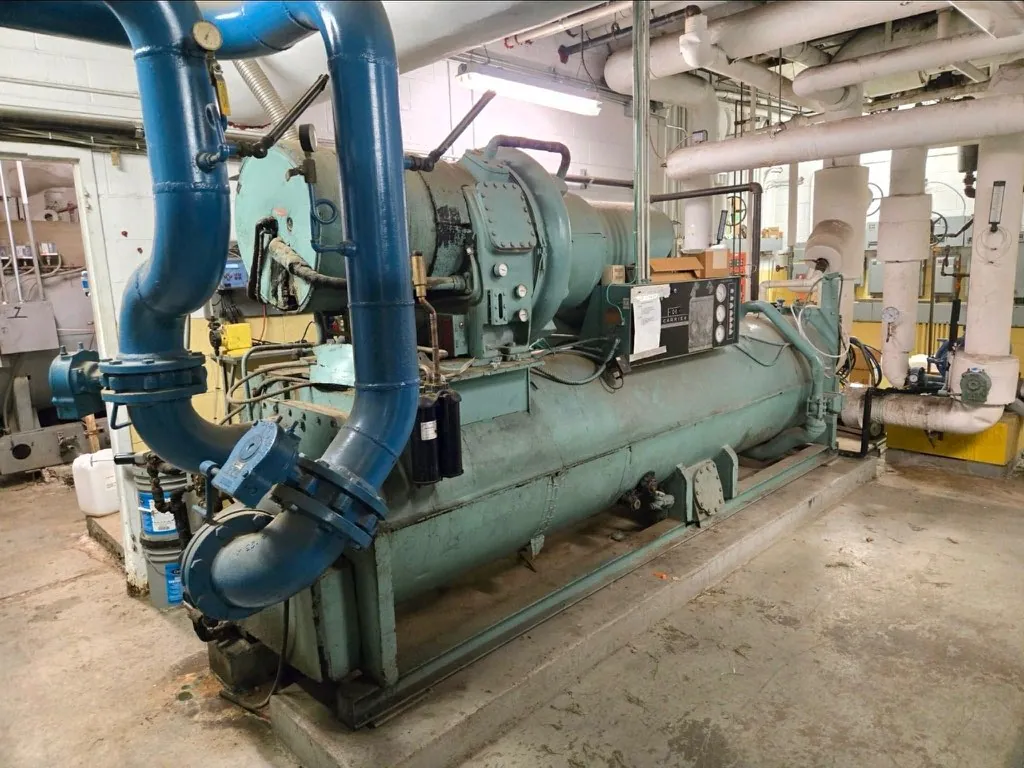
Sell a 300–399 Ton Chiller
We consider chillers rated 300 to 399 tons and handle the agreed removal and freight throughout South Carolina.
We buy chillers. We don’t sell them.
Your chiller.
Our logistics.
Have a surplus or decommissioned chiller? We’re the buyer—here to make moving it straightforward.
From a single unit to equipment from a larger facility, tell us what you have. We buy industrial and commercial chillers across South Carolina and coordinate the work to get them moved.
See how it works
All types & sizes
Air-cooled or water-cooled, centrifugal, screw or scroll. Tell us what you have.
We handle the logistics
We coordinate rigging, refrigerant recovery, loading and freight for the equipment we buy.
Made for sellers
Send the details and nameplate photos to start a conversation about your chiller.
Three steps.
One less chiller.
- 01
Send the details
Share what you know, along with photos of the unit and nameplate.
- 02
Get a quote
We’ll review your equipment and discuss an offer with you.
- 03
Leave the logistics to us
We coordinate removal and freight for the chillers we purchase.
Sell a 300–399 Ton Chiller in South Carolina
South Carolina Chiller Buyers purchases used chillers, including units rated from 300 to 399 tons. We are a direct buyer, not a seller of replacement equipment. If you are considering selling a chiller in this range, a clear description of the equipment and its condition helps us assess whether it fits a purchase and removal plan.
Capacity is only one part of the decision. The unit’s physical configuration, included components, access route and transport requirements can all affect an offer and the removal schedule. We consider chillers of all tonnages, from below 20 tons to 2,000 tons and above, across all brands and refrigerants.
Document the Rating and the Complete Package
If the nameplate shows a capacity between 300 and 399 tons, send a readable photograph of the entire label. Include the manufacturer and, if known, the compressor and condenser types. Explain whether the stated capacity comes from the actual unit’s nameplate, a drawing or an estimate; those sources are not interchangeable, and a drawing may describe a design rather than the equipment now on site.
Describe the chiller as a package, not just as a main cabinet. A separate starter, variable-frequency drive, controller or other component may be part of the sale if included. For a unit in storage, note where those pieces are kept and whether they are offered with the chiller. Photographs of the main equipment and separate components can help clarify what is available without asking anyone to power up or dismantle the system.
Show the Equipment and Its Exit Route
Photograph your 300–399 ton chiller from several useful angles, including a broad view that shows its overall arrangement. Photograph the route from the unit to the loading point as well. Doorways, turns, overhead obstructions, stairs, floor transitions and the distance to a suitable pickup area may matter to removal planning.
Do not infer transport dimensions or weight from the tonnage rating. Tonnage describes cooling capacity; it does not tell us the chiller’s shipping weight or the space needed to move it. If reliable dimensions or weight are already available in records, share them, but do not create measurements by opening, cutting or dismantling equipment. The buyer can review the available information and determine what additional planning is appropriate.
Condition Notes That Help Set Expectations
Share what you know about the unit’s operating history and current status: for example, whether it is in service, retired, stored, or known to have a fault. If it has not been tested recently, say so. You do not need to start, test, repair or prepare the chiller to request an offer. Avoid guessing about internal condition when records or direct observations do not support a conclusion.
Keep refrigerant and process fluid distinct in your description. Refrigerant is part of the chiller’s cooling circuit; process fluid, such as water or another circulating medium, belongs to the connected system. If you know whether either remains in the equipment, report that information, but do not drain, release or handle either fluid for the purpose of requesting a purchase offer.
When a Stored Unit May Be Worth Discussing
A chiller that is no longer needed may still merit review even if it is out of service or stored with its controls separated. For example, if a facility has retained the chiller and a detached starter after a project change, photographs and a clear inventory may help establish whether both are included. If the starter is missing or its location is uncertain, identify that uncertainty rather than presenting it as part of the package.
Likewise, if the nameplate is difficult to read or the capacity is known only from an old drawing, send the best available documentation and explain the limitation. These are illustrative situations, not assumptions about any particular South Carolina site. The offer and removal plan depend on the actual equipment and the agreement reached.
How Purchase and Removal Are Arranged
Payment is upfront after the purchase terms are agreed. Following an agreed purchase, South Carolina Chiller Buyers handles disconnects, necessary refrigerant recovery through appropriately qualified personnel, crane and rigging, loading, hauling and freight. Freight is covered. Sellers do not need to hire a carrier or ship the chiller themselves.
The authorized owner or site representative must still approve the transaction and coordinate access. Provide relevant access details and identify any site procedures that the removal team will need to follow. The equipment, site conditions and agreed scope inform the removal schedule; no specific date or price can be promised before those details are reviewed.
Information to Send for an Offer
- A full nameplate photograph and the source of the stated 300–399 ton rating.
- Manufacturer, compressor or condenser type, and known condition or operating status.
- Photographs of the chiller, any included separate starter or drive, and the exit route.
- Known access constraints, available dimensions or weight records, and confirmation that the authorized representative can coordinate access.
With those details, we can review your used 300–399 ton chiller in South Carolina and discuss whether a purchase makes sense. You can request an offer without testing, repairing or preparing the equipment.
Ready to move
your chiller?
Tell us what you know. If you’re unsure of a detail, leave it blank. Nameplate photos are a great place to start.

Request a quote.
Fill out what you can and we’ll be in touch.