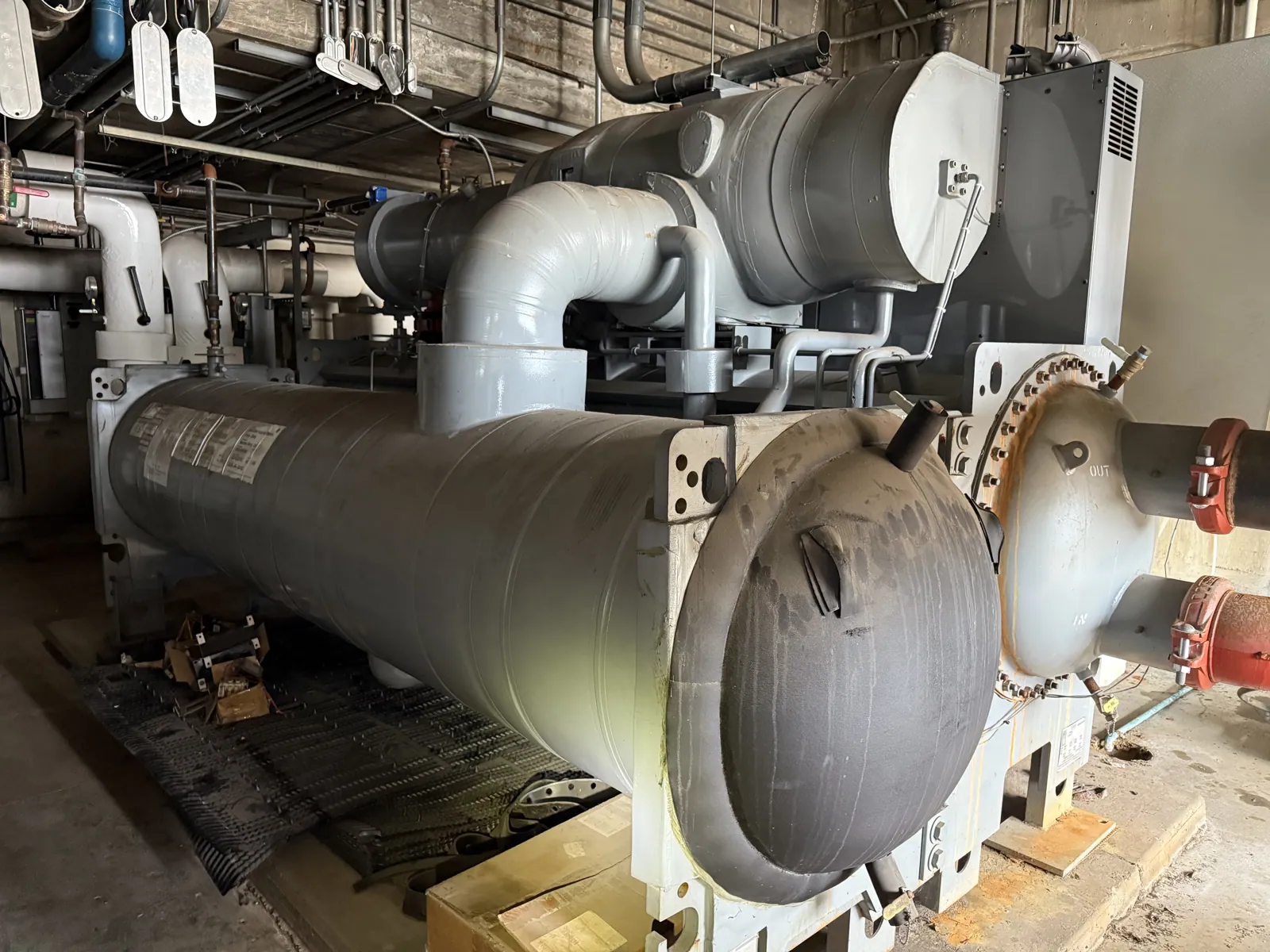
Sell a Used Government Facility Chiller
We buy surplus government facility chiller equipment and manage removal in coordination with the property.
We buy chillers. We don’t sell them.
Your chiller.
Our logistics.
Have a surplus or decommissioned chiller? We’re the buyer—here to make moving it straightforward.
From a single unit to equipment from a larger facility, tell us what you have. We buy industrial and commercial chillers across South Carolina and coordinate the work to get them moved.
See how it works
All types & sizes
Air-cooled or water-cooled, centrifugal, screw or scroll. Tell us what you have.
We handle the logistics
We coordinate rigging, refrigerant recovery, loading and freight for the equipment we buy.
Made for sellers
Send the details and nameplate photos to start a conversation about your chiller.
Three steps.
One less chiller.
- 01
Send the details
Share what you know, along with photos of the unit and nameplate.
- 02
Get a quote
We’ll review your equipment and discuss an offer with you.
- 03
Leave the logistics to us
We coordinate removal and freight for the chillers we purchase.
Sell a Used Government Facility Chiller in South Carolina
South Carolina Chiller Buyers purchases surplus government facility chillers; we are a direct buyer, not a seller of replacement equipment. If a chiller is inactive and its service history is incomplete, you can still request an offer. You do not need to test, start, repair, or prepare the unit first. Share what is known, identify what is uncertain, and let the buyer assess the equipment and removal scope before any agreement is made.
Start with ownership and approval
A public facility may have an internal surplus-property process, approval chain, or contracting procedure that applies before equipment can be sold. Confirm who is authorized to discuss a transaction and whether the chiller is eligible for disposal. A facilities employee may know the equipment best without having authority to approve a sale, so establish the proper contact before treating an inquiry as a commitment.
Approval remains subject to the owner’s actual rules. If the asset is controlled by another agency or department, clarify who must authorize its sale and removal. South Carolina Chiller Buyers can discuss the proposed purchase and work scope with the authorized representative, but cannot substitute for the facility’s internal approvals.
Build a useful picture without restarting the machine
For an inactive chiller with uncertain history, begin with records and observations already available. Useful details may include the manufacturer, model, serial number, nominal capacity, approximate location, and any known refrigerant or past operating issue. Existing nameplate information, asset records, maintenance documents, or photographs can help; do not open panels or approach unsafe areas to obtain them. An unknown field is better reported as unknown than guessed.
Tell the buyer whether the machine is believed to be complete, whether components are known to be missing, and whether access appears restricted. These are preliminary descriptions, not a demand for you to inspect or prepare the equipment. Do not energize, open, drain, vent, cut, or dismantle the chiller to improve an offer request.
Capacity is not the same as removal weight
Chiller capacity, usually discussed in tons, describes cooling output; it does not tell a mover how heavy or difficult the equipment will be to transport. Physical dimensions, configuration, installed location, route to an exit, and available rigging access all affect removal planning. If weight is not documented, do not estimate it from capacity alone. The buyer can discuss what information is needed to evaluate the particular unit and site.
We consider chillers of all tonnages, including units below 20 tons. Equipment from 20 to 2,000+ tons is also a common range, but size alone does not determine whether a chiller can be purchased. All brands and all refrigerants are considered. A request is not a promise of purchase: the offer and removal schedule depend on the equipment and the agreement.
Keep refrigerant and process fluid distinct
Refrigerant is part of the chiller’s cooling circuit; process fluid, such as water or a water-glycol mixture, may circulate through a separate side of the system. Knowing which fluids are present can help describe the installation, but uncertainty is acceptable. Do not drain or release anything to identify it. After an agreed purchase, the buyer handles necessary refrigerant recovery through appropriately qualified personnel as part of the removal work.
Plan access and site protocols
Before removal is scheduled, identify applicable site-entry steps: check-in requirements, escorted areas, restricted zones, work-hour limits, and any documents the facility requires from a removal contractor. Share known constraints with the buyer so the scope can be discussed. The authorized owner or site representative must grant permission and coordinate access; purchase discussions do not override security or property rules.
For example, if a chiller sits behind a controlled-access area, the facility may need to arrange an escort or approve contractor paperwork before a visit. If the unit is in a plant room with a narrow route, the buyer may need to understand that constraint when considering equipment handling. These are planning possibilities, not assumptions about any particular South Carolina facility.
What happens after agreement
Once the purchase is agreed, the buyer handles disconnects, necessary refrigerant recovery by appropriately qualified personnel, crane and rigging needs, loading, hauling, and freight. Freight is covered. The seller does not need to hire a mover or ship the chiller. The facility still provides authorized permission and coordinates access, while the buyer and site representative work through the agreed removal scope and timing.
A practical information checklist
When requesting an offer for a surplus government facility chiller, gather what is readily available:
- Authorized contact and status of required surplus or contracting approvals
- Known manufacturer, model, serial number, capacity, refrigerant, and service-history gaps
- Current location, known access restrictions, and any contractor-entry documents or protocols
South Carolina Chiller Buyers can review the available information and discuss an offer without requiring the unit to be operational. No price or removal date should be assumed until the equipment, site conditions, approvals, and agreement have been considered.
Ready to move
your chiller?
Tell us what you know. If you’re unsure of a detail, leave it blank. Nameplate photos are a great place to start.

Request a quote.
Fill out what you can and we’ll be in touch.