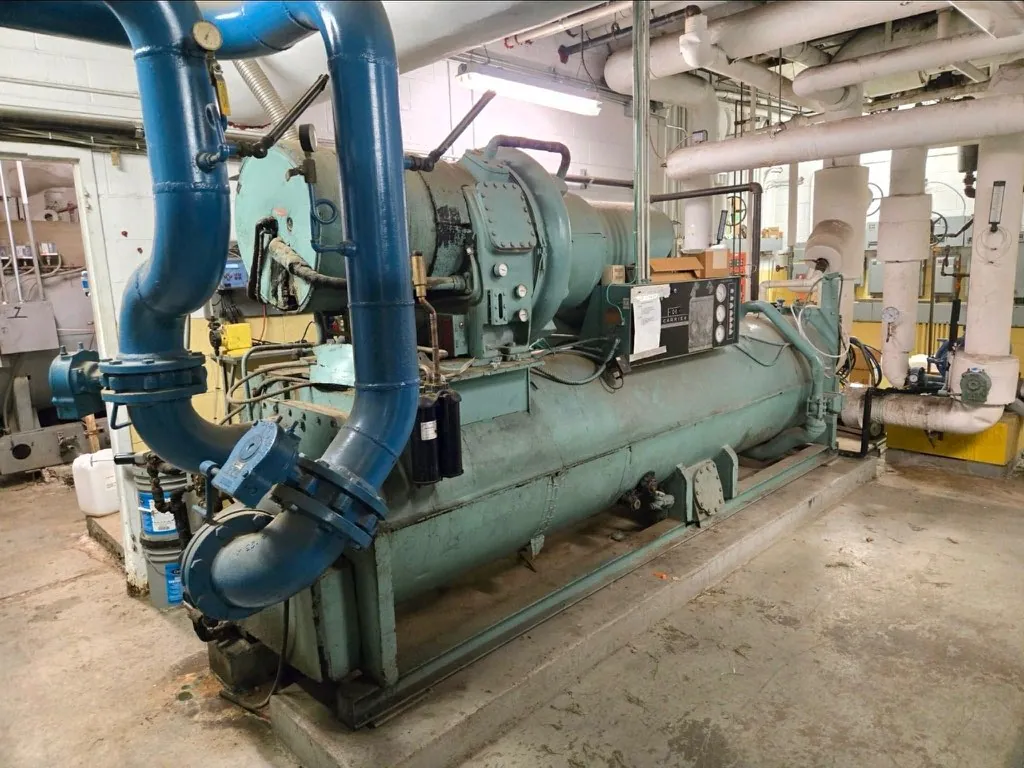
Sell Without Testing in South Carolina
Understand chiller sale without testing and the information needed for a direct chiller purchase in South Carolina.
We buy chillers. We don’t sell them.
Your chiller.
Our logistics.
Have a surplus or decommissioned chiller? We’re the buyer—here to make moving it straightforward.
From a single unit to equipment from a larger facility, tell us what you have. We buy industrial and commercial chillers across South Carolina and coordinate the work to get them moved.
See how it works
All types & sizes
Air-cooled or water-cooled, centrifugal, screw or scroll. Tell us what you have.
We handle the logistics
We coordinate rigging, refrigerant recovery, loading and freight for the equipment we buy.
Made for sellers
Send the details and nameplate photos to start a conversation about your chiller.
Three steps.
One less chiller.
- 01
Send the details
Share what you know, along with photos of the unit and nameplate.
- 02
Get a quote
We’ll review your equipment and discuss an offer with you.
- 03
Leave the logistics to us
We coordinate removal and freight for the chillers we purchase.
Sell a Chiller Without Testing During a Property Closure
If a South Carolina property is closing, changing use, or clearing out equipment, you may need to decide what to do with a chiller before anyone can demonstrate that it runs. South Carolina Chiller Buyers is a direct buyer of used and surplus chillers, not a seller of replacement equipment. You do not need to start, test, or repair your chiller before asking for an offer. A clear account of what is known—and what is not—is more useful than an unsafe or unnecessary attempt to prove performance.
Start by confirming who is authorized to discuss the equipment. The owner or an authorized site representative must approve a potential sale and coordinate access. A property manager, contractor, or closing representative can help with communication, but should not assume they have authority to sell unless the owner has granted it.
A Practical Decision Path for a Closing Site
First, identify the chiller and gather information already available. Next, decide whether the unit can be photographed safely from an accessible area. Then share its known condition, any limits on access, and the timing considerations tied to the closure. South Carolina Chiller Buyers can review that information and discuss a purchase; the offer and removal schedule depend on the equipment and the agreement.
For example, if a building is already de-energized and access is restricted, do not try to restore power or enter a controlled area just to create a demonstration. Explain the restriction and provide existing records instead. If the unit remains accessible, a photo of its identification plate and an overall view may help, provided taking them does not require opening panels, moving equipment, or entering an unsafe area.
Share What You Know, Without Creating New Risk
Useful details can include the manufacturer and model, approximate capacity if known, whether the chiller is installed or already disconnected, and any known history of faults or repairs. Be explicit about uncertainty: “last reported operating,” “condition unknown,” or “not recently inspected” is better than presenting an assumption as a verified result.
Do not energize, open, drain, vent, cut, or dismantle the chiller to prepare it for an offer. If records are available, such as an equipment list or prior service paperwork, you can share them without commissioning new work. Existing documentation can clarify the unit’s identity and condition, but it does not guarantee a particular value.
Photographs and Records Are Optional Aids
If safe and permitted, photograph the equipment plate and the overall unit. Avoid removing covers or approaching hazards to get a closer image. If photography is not possible, say why: access may be restricted, the room may be controlled, or the chiller may be de-energized as part of the closure. These are practical limitations to report, not reasons to attempt a test.
Keep any records in context. A plate may identify a model or rated capacity, while service notes may describe work performed at an earlier date. Neither establishes the chiller’s present operating condition by itself. Clear descriptions of the limits of each record help the buyer assess what can reasonably be considered.
Capacity Is Not Removal Weight
Chillers are considered across all tonnages, including units below 20 tons; 20 to 2,000+ tons is a common range, not a cutoff. Capacity describes cooling output, not the weight or dimensions that determine how equipment can be removed. A compact unit can still present access or lifting challenges, while a large-capacity chiller may require substantial planning for rigging and transport.
Share what is known about the unit’s location, route to an exit, and any access constraints, without measuring or moving equipment if doing so would be unsafe. Removal planning is based on the specific chiller and site conditions, not tonnage alone. All brands and refrigerants are considered.
What Happens After an Agreed Purchase
After a purchase is agreed, the buyer handles the disconnects, necessary refrigerant recovery through appropriately qualified personnel, crane and rigging, loading, hauling, and freight. Freight is covered. The seller does not need to hire a carrier or ship the chiller. The authorized owner or site representative still needs to grant permission and coordinate access so the work can be planned around the property’s closure.
Payment is upfront. The removal schedule is arranged according to the equipment, site access, and agreement; do not assume a specific date before those details are reviewed. If the closing has a deadline, share it early so it can be considered, without treating it as a guaranteed removal date.
What to Send When Requesting an Offer
A concise, accurate description is enough to begin a conversation. Include the following where available:
- Make, model, and capacity from existing information
- Known or unknown operating condition, without a new test
- Whether the unit is installed, de-energized, or access-restricted
- Safe photographs or existing records, if available
- Owner authorization and relevant closure or access timing
You can request an offer even if some details are missing. State the gaps plainly, and let the buyer determine what additional information is needed. The goal is to make a sound decision about surplus equipment during a property transition—not to put staff, contractors, or the chiller at risk for a performance demonstration.
Ready to move
your chiller?
Tell us what you know. If you’re unsure of a detail, leave it blank. Nameplate photos are a great place to start.

Request a quote.
Fill out what you can and we’ll be in touch.