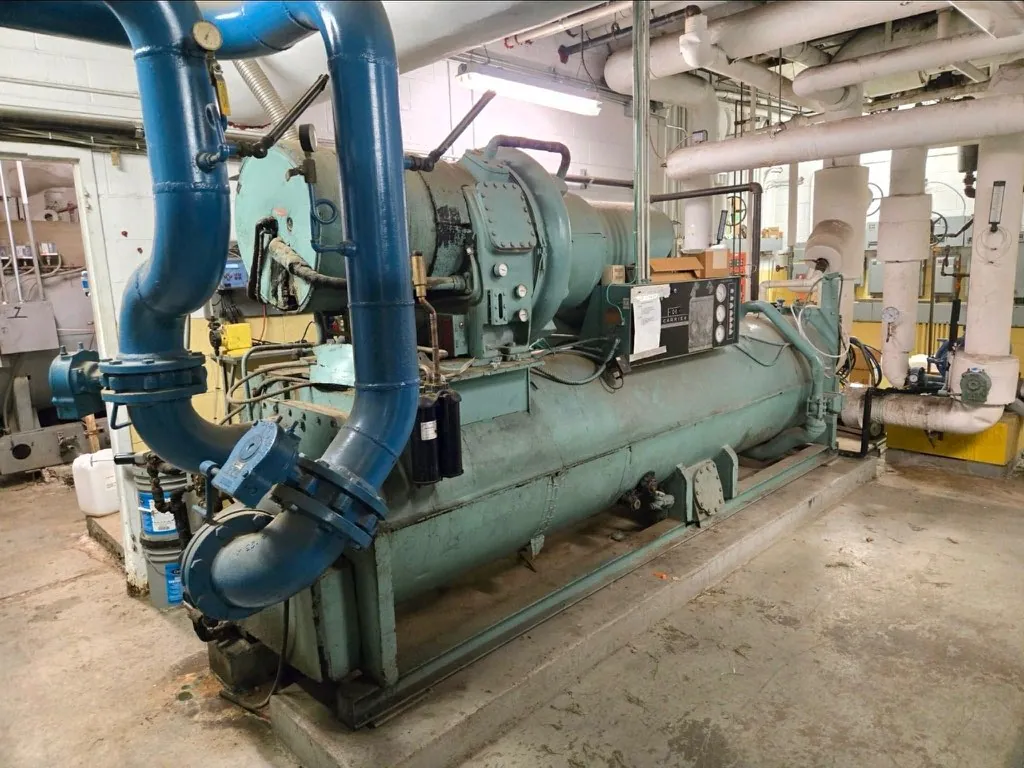
Sell Your Used Screw Chiller
We buy surplus screw chiller equipment throughout South Carolina and manage the agreed removal.
We buy chillers. We don’t sell them.
Your chiller.
Our logistics.
Have a surplus or decommissioned chiller? We’re the buyer—here to make moving it straightforward.
From a single unit to equipment from a larger facility, tell us what you have. We buy industrial and commercial chillers across South Carolina and coordinate the work to get them moved.
See how it works
All types & sizes
Air-cooled or water-cooled, centrifugal, screw or scroll. Tell us what you have.
We handle the logistics
We coordinate rigging, refrigerant recovery, loading and freight for the equipment we buy.
Made for sellers
Send the details and nameplate photos to start a conversation about your chiller.
Three steps.
One less chiller.
- 01
Send the details
Share what you know, along with photos of the unit and nameplate.
- 02
Get a quote
We’ll review your equipment and discuss an offer with you.
- 03
Leave the logistics to us
We coordinate removal and freight for the chillers we purchase.
Sell Your Used Screw Chiller in South Carolina
South Carolina Chiller Buyers purchases used screw chillers directly from their owners. We buy equipment; we do not sell replacement chillers. If you are considering selling a screw chiller during a plant change, equipment upgrade, or building transition, start by sharing what you know about the unit and its location. You do not need to start, test, repair, or prepare the machine to request an offer.
We consider screw chillers at all tonnages, including units below 20 tons. Equipment from 20 to 2,000 tons and above is also within the range we commonly consider. We review all brands and refrigerants. An offer and a possible removal schedule depend on the specific equipment, access conditions, and the terms agreed with the owner or authorized site representative.
Describe the Configuration, Not Just the Capacity
Screw chillers use rotary screw compression, but the word “screw” alone does not establish how a particular unit is built. Tell us whether your chiller is air-cooled or water-cooled, and whether its compressors, drives, and control panels remain attached. If you have a manufacturer plate, asset record, or existing documentation, its information may help identify the unit; do not open or dismantle equipment to look for details.
Capacity is useful for describing cooling output, but it is not the same as transport weight. A tonnage rating does not tell a rigging crew the unit’s actual weight, dimensions, lifting points, or the requirements of the route out of the building. If available, share nameplate details, drawings, or prior removal records. These details can help distinguish a compact chiller from a larger assembly that needs more involved access planning.
Share Known Condition Without Running the Machine
Maintenance notes can add useful context even if the chiller is no longer operating. You may report a known compressor fault, a previous retrofit, missing components, or a service history recorded by your organization. You are not expected to confirm a suspected fault by energizing the unit or to perform troubleshooting. The buyer can assess the information provided and account for it when considering the equipment and planning a disconnect.
Keep descriptions factual: for example, distinguish a documented fault from an uncertain report, and note whether a control panel or drive is believed to be absent rather than assuming its condition. The buyer considers the unit as presented; there is no requirement that it be running, repaired, or demonstrated before you request an offer.
Roof Access Can Shape a Conditional Removal Plan
If your screw chiller is on a roof, site permission and crane access may be important parts of the discussion. For example, if a hypothetical rooftop unit sits behind a restricted gate or above an area with limited crane setup space, the site representative may need to explain access rules and identify who can authorize entry. That does not establish that a crane can reach the unit; the actual route, lifting conditions, and schedule must be assessed for the specific site and agreement.
Share known constraints such as roof access procedures, loading-area restrictions, or time windows for work. Do not arrange a crane, disconnect the chiller, or ship the equipment yourself. After a purchase is agreed, South Carolina Chiller Buyers handles disconnects, necessary refrigerant recovery through appropriately qualified personnel, crane and rigging, loading, hauling, and freight. Freight is covered. The authorized owner or site representative still needs to provide permission and coordinate access.
Keep Refrigerant and Process Fluid Distinctions Clear
Refrigerant is part of the chiller’s refrigeration circuit; process fluid or chilled water is associated with the system the chiller serves. Information about one does not automatically describe the other. If you know the refrigerant type or have system records, share them as available. Do not vent, drain, open, or cut into the equipment or connected lines. Any necessary refrigerant recovery after an agreed purchase is handled by appropriately qualified personnel as part of the buyer’s removal work.
A chiller’s refrigerant type does not by itself determine whether it can be considered. We review all refrigerants, along with the equipment’s overall condition, configuration, and removal circumstances.
Useful Details to Include in Your Request
- Brand, model, approximate capacity, and any available identification records.
- Whether the unit is air-cooled or water-cooled, plus the known compressor and drive configuration.
- Whether compressors, drives, and control panels remain attached, and any known fault or retrofit.
- Where the chiller is located and what permission or access coordination may be required.
What Happens After an Offer Is Agreed
Payment is upfront under the agreed purchase arrangement. Removal timing is not guaranteed in advance: the schedule depends on the equipment, access, and agreement. If the unit is elevated, unusually restricted, or missing components, those facts can affect planning. Provide accurate information where possible, and raise uncertainties rather than making assumptions about condition or removal requirements.
To discuss selling your used screw chiller in South Carolina, share the details you have and identify the authorized person who can coordinate site access. You do not need to make the machine operational or prepare it for shipment. Once the purchase terms and removal plan are agreed, the buyer manages the stated removal and freight responsibilities.
Ready to move
your chiller?
Tell us what you know. If you’re unsure of a detail, leave it blank. Nameplate photos are a great place to start.

Request a quote.
Fill out what you can and we’ll be in touch.