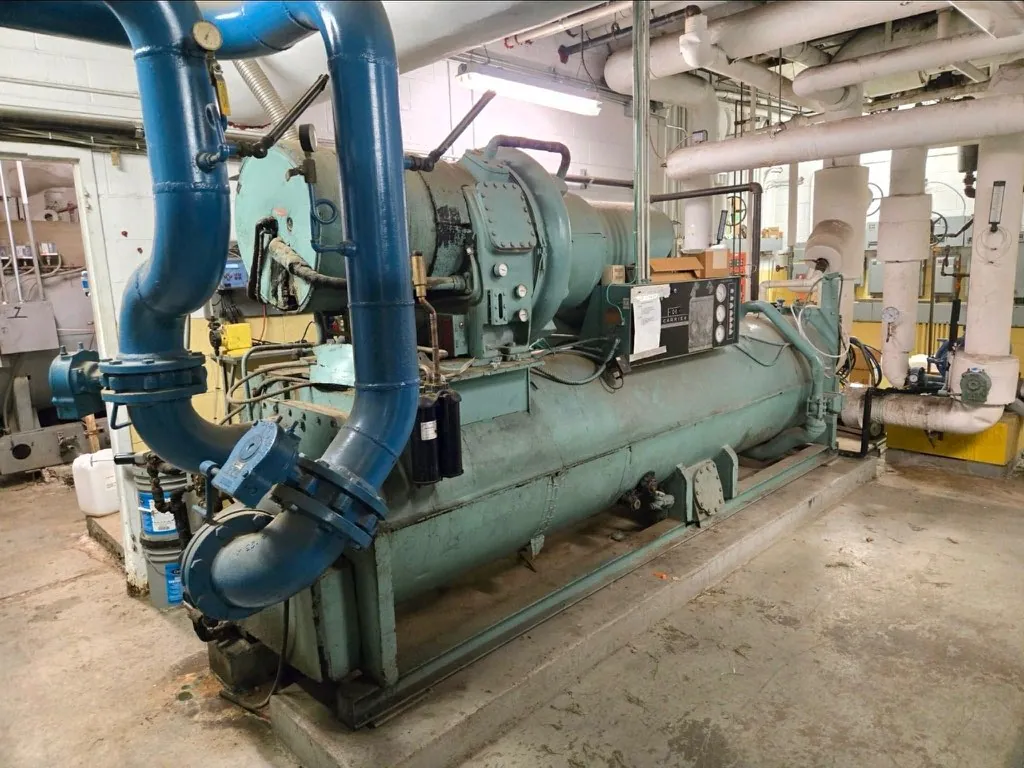
Sell Your Used Industrial Chiller
We buy surplus industrial chiller equipment throughout South Carolina and manage the agreed removal.
We buy chillers. We don’t sell them.
Your chiller.
Our logistics.
Have a surplus or decommissioned chiller? We’re the buyer—here to make moving it straightforward.
From a single unit to equipment from a larger facility, tell us what you have. We buy industrial and commercial chillers across South Carolina and coordinate the work to get them moved.
See how it works
All types & sizes
Air-cooled or water-cooled, centrifugal, screw or scroll. Tell us what you have.
We handle the logistics
We coordinate rigging, refrigerant recovery, loading and freight for the equipment we buy.
Made for sellers
Send the details and nameplate photos to start a conversation about your chiller.
Three steps.
One less chiller.
- 01
Send the details
Share what you know, along with photos of the unit and nameplate.
- 02
Get a quote
We’ll review your equipment and discuss an offer with you.
- 03
Leave the logistics to us
We coordinate removal and freight for the chillers we purchase.
Sell Your Used Industrial Chiller in South Carolina
South Carolina Chiller Buyers purchases used industrial chillers directly from owners in South Carolina. If a machine is inactive and its service history is incomplete, you do not need to establish that it runs before asking about a sale. We consider chillers of all tonnages, including units below 20 tons; 20 to 2,000+ tons is a common range. We buy all brands and refrigerants, and we are a buyer—not a seller of replacement equipment.
A useful first step is to record what you can identify without disturbing the equipment. Check existing nameplate photographs, maintenance files, purchase records, or information available from the person responsible for the site. If details are missing, say so. An uncertain history is a reason to describe what is known and unknown, not to guess or attempt a test run.
Start With the Machine’s Identity
“Industrial chiller” describes a broad class of equipment, not a particular compressor or condenser design. For an initial review, the most useful identifiers are the manufacturer, model, stated capacity, refrigerant, and whether the machine is air-cooled or water-cooled. A photograph of an accessible nameplate can help, but do not open panels or approach unsafe areas to obtain one.
Capacity and physical weight answer different questions. Tonnage describes cooling capacity; it does not tell a rigging team how heavy the packaged machine is or whether it can pass through the available route. If shipping or equipment records list weight or dimensions, share them as available. If not, do not estimate by lifting, dismantling, or moving the chiller. The actual removal plan depends on the equipment and site conditions.
Describe an Unknown Service History Honestly
For an inactive unit, separate verified facts from reports or assumptions. For example, you may know that it has been out of service since a particular period, while not knowing why it stopped or when it was last inspected. A former operator’s account can be useful context, but label it as reported rather than confirmed. This gives the buyer a clearer basis for considering the equipment without making operation or repair a condition of requesting an offer.
Do not energize the chiller, open it, drain it, vent refrigerant, cut connections, or dismantle components to answer questions. Sellers do not need to test, start, repair, or prepare the unit to request an offer. If records are incomplete, state that plainly and provide the identifiers and visible information already available.
Clarify What Is Included in the Sale
A factory installation may have control wiring, process piping, or structural supports alongside the packaged chiller. These may serve other site equipment and should not automatically be treated as part of the sale. Identify, as clearly as you can, which items belong with the chiller and which must remain. Explain any known access restrictions, shared connections, overhead obstructions, or limits on working hours so disconnects, rigging, and freight can be planned together.
Process fluid and refrigerant are not interchangeable. Process fluid circulates through the system being cooled; refrigerant is contained in the chiller’s refrigeration circuit. If you know what process served the unit, that can help describe its use, but do not drain or handle either circuit for an inquiry. Necessary refrigerant recovery is handled through appropriately qualified personnel as part of an agreed removal plan.
Useful Details to Gather
- Manufacturer, model, stated tonnage, refrigerant, and air-cooled or water-cooled design, if known.
- Available photographs or records, plus a clear note about any uncertain or missing history.
- What equipment, piping, wiring, or supports are included, and any known access limitations.
This information is a practical starting point, not a requirement to certify the unit or prepare it for pickup. If some details cannot be confirmed from records or safely visible information, identify the gaps rather than trying to investigate the machine.
Plan Removal Around the Site
After a purchase is agreed, South Carolina Chiller Buyers handles disconnects, necessary refrigerant recovery through appropriately qualified personnel, crane and rigging, loading, hauling, and freight. Freight is covered. The authorized owner or site representative still needs to provide permission and coordinate access, including any relevant entry procedures or scheduling constraints.
Removal arrangements depend on the particular equipment, its location, access, and the agreement. A stated tonnage alone cannot establish transport weight, rigging needs, route clearance, or a removal date. Share known site constraints early; the removal schedule is determined with the equipment and access plan in view, not promised from a brief description.
Request an Offer Without Restarting the Chiller
Once you have gathered the information that is readily available, contact South Carolina Chiller Buyers for an offer. Payment is upfront after the purchase is agreed. You do not have to restore service, arrange freight, hire a contractor to prepare the machine, or prove the chiller’s operating condition just to ask. If the history is uncertain, the model is unclear, or the capacity is below 20 tons, include those facts in your description so the equipment can be considered on its actual circumstances.
Ready to move
your chiller?
Tell us what you know. If you’re unsure of a detail, leave it blank. Nameplate photos are a great place to start.

Request a quote.
Fill out what you can and we’ll be in touch.