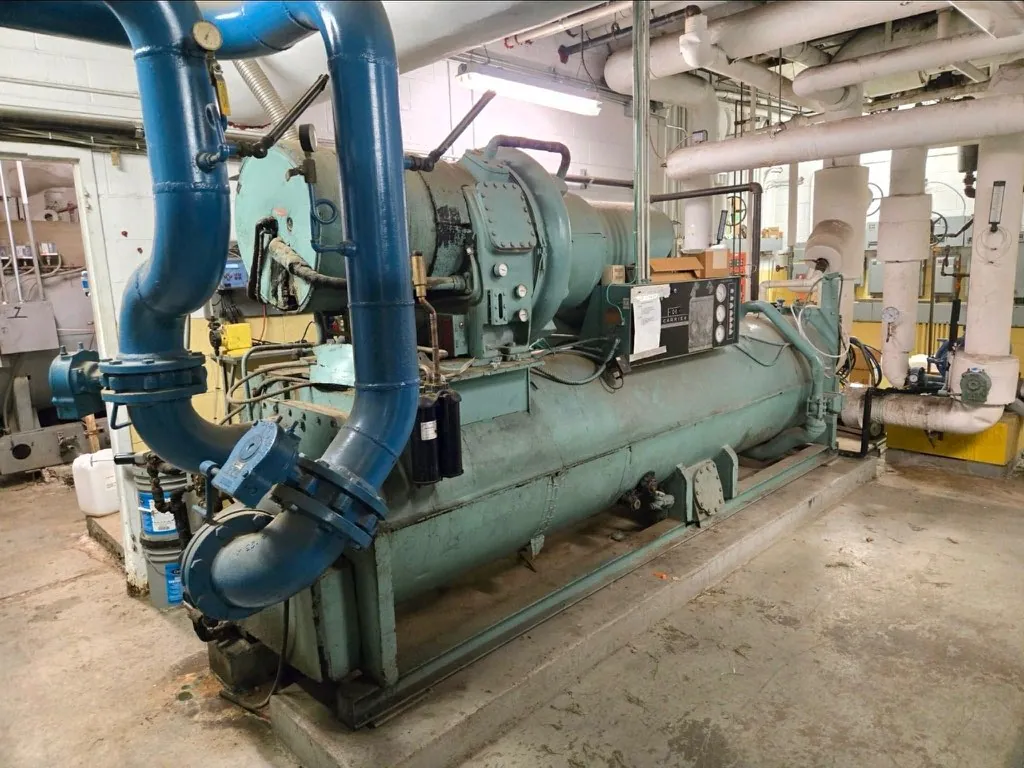
Sell a Used Chiller in Simpsonville, SC
We buy used and surplus industrial chillers in Simpsonville, with upfront payment and buyer-managed removal.
We buy chillers. We don’t sell them.
Your chiller.
Our logistics.
Have a surplus or decommissioned chiller? We’re the buyer—here to make moving it straightforward.
From a single unit to equipment from a larger facility, tell us what you have. We buy industrial and commercial chillers across South Carolina and coordinate the work to get them moved.
See how it works
All types & sizes
Air-cooled or water-cooled, centrifugal, screw or scroll. Tell us what you have.
We handle the logistics
We coordinate rigging, refrigerant recovery, loading and freight for the equipment we buy.
Made for sellers
Send the details and nameplate photos to start a conversation about your chiller.
Three steps.
One less chiller.
- 01
Send the details
Share what you know, along with photos of the unit and nameplate.
- 02
Get a quote
We’ll review your equipment and discuss an offer with you.
- 03
Leave the logistics to us
We coordinate removal and freight for the chillers we purchase.
Turn an incomplete chiller inventory into a clear offer discussion
If you are searching for a “chiller buyer near me” and the equipment is in Simpsonville, South Carolina, South Carolina Chiller Buyers can discuss a direct purchase. You do not need a complete asset register before making contact. A few reliable details can help identify what is being offered, while unknown information can be noted rather than guessed.
We buy used and surplus chillers; we do not sell replacement equipment. The equipment might be in a closed factory, an occupied commercial property, a campus, a power plant, or a data center. Describe the actual setting and identify who has authority to sell. For a site with tenants, operations staff, or restricted access, it is also useful to establish who can approve a site visit and coordinate entry.
Start with the equipment that is actually for sale
A sale may involve one packaged chiller or several machines in a central plant. Make a short list of the specific unit or units being considered, using a tag, nameplate description, location within the building, or another identifier that your team can verify safely. If the inventory is incomplete, say which details are confirmed and which still need checking.
Clarify whether each unit is air-cooled or water-cooled and whether accessories are part of the proposed sale. For example, a controller, pump, cooling tower, or separate piping may be included or excluded depending on the agreement. Do not assume that nearby equipment automatically transfers with the chiller. A simple boundary—what the buyer may remove and what must remain—can prevent confusion later.
Capacity helps identify a machine, but it is not its transport weight
Share the stated capacity or model information if available. We consider chillers of all tonnages, including units below 20 tons; 20 to 2,000+ tons is a common range, not a minimum or a limit. All brands and all refrigerants are considered. If a nameplate is missing or difficult to access, provide the information already in your records rather than trying to reach or expose it.
Cooling capacity, expressed in tons, describes cooling output; it does not tell a rigger how heavy or large the unit is. Transport planning depends on the equipment’s physical dimensions, weight, configuration, access route, and lifting conditions. A compact-looking machine may still require substantial handling, while a large chiller may have components or constraints that affect removal. If documented drawings or old installation records are available, they can help, but you do not need to create new measurements by dismantling anything.
Describe condition without starting or opening the chiller
Useful condition notes can come from existing maintenance records, an old equipment schedule, prior operating reports, or a visible exterior inspection performed as part of normal site duties. You can report whether the unit is known to be operating, idle, incomplete, or of unknown status. Do not energize, open, drain, vent, cut, or dismantle a chiller to prepare for an offer. Testing, repair, and special preparation are not prerequisites for requesting one.
If the refrigerant type or charge information is known from records, include it; if not, mark it unknown. Refrigerant is distinct from process or chilled-water fluid that may circulate through connected systems. Neither should be released or removed to improve the sale discussion. After an agreed purchase, necessary refrigerant recovery is handled through appropriately qualified personnel as part of the buyer’s removal work.
One unit or a group: make the sale boundary explicit
For a single chiller, identify that machine and any accessories included in the offer. For several central-plant machines, a unit-by-unit list is helpful even when details are sparse. One chiller might be surplus while another remains essential to building operations; distinguishing them helps avoid treating the entire plant as available when only part of it is being sold.
- Record the unit identifier or best available description, approximate capacity if known, air- or water-cooled arrangement, known condition, included accessories, and any access constraints.
- Mark uncertain items as unknown rather than filling gaps with estimates presented as fact.
These notes are a starting point, not a demand for a finished engineering inventory. If several machines share a room or access route, mention that relationship so the scope can be discussed in practical terms.
Access and removal are part of the purchase conversation
The authorized owner or site representative must provide permission and coordinate access. Explain any relevant limits, such as operating hours, security procedures, occupied areas, overhead obstructions, or a narrow route from the plant room. These are planning details, not reasons to arrange your own shipping or hire a removal crew.
After the purchase is agreed, the buyer handles disconnects, necessary refrigerant recovery through appropriately qualified personnel, crane and rigging, loading, hauling, and freight. Freight is covered. The seller is not expected to test, start, repair, prepare, dismantle, or ship the chiller. The removal approach and schedule depend on the equipment, site conditions, and agreement; neither a specific removal date nor a particular method should be assumed before those details are reviewed.
Request an offer with the facts you have
South Carolina Chiller Buyers provides upfront payment for an agreed purchase. The offer depends on the equipment and the terms reached, so an incomplete inventory is best handled with transparent notes rather than an invented valuation. Send the confirmed identifiers, location in Simpsonville, included or excluded items, known condition, and access contact. Add records or photographs only when they are already available and can be shared safely.
If key information is missing, explain what is unknown and who may be able to verify it. That gives us a practical basis to discuss your chiller in Simpsonville without asking you to put equipment back in service or alter it. Once the scope and site access are understood, the purchase and removal arrangements can be considered together.
Ready to move
your chiller?
Tell us what you know. If you’re unsure of a detail, leave it blank. Nameplate photos are a great place to start.

Request a quote.
Fill out what you can and we’ll be in touch.