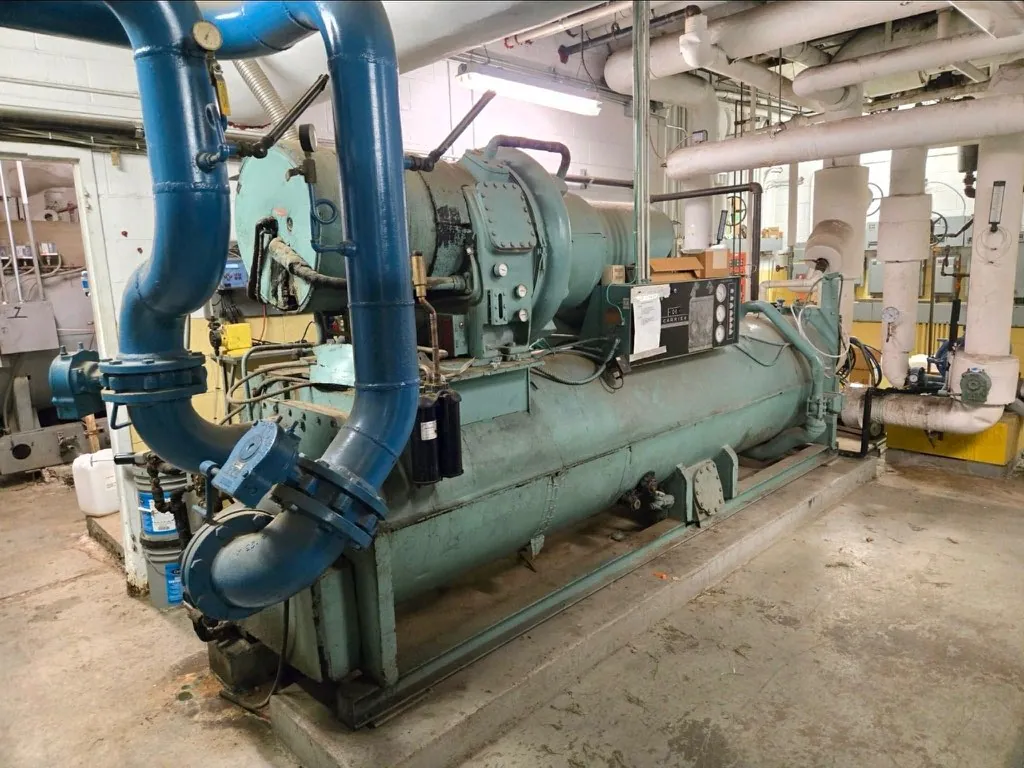
Sell a Surplus Centrifugal Chiller in Laurens, SC
We buy used centrifugal chiller equipment in Laurens and handle the agreed disconnect, rigging, and freight.
We buy chillers. We don’t sell them.
Your chiller.
Our logistics.
Have a surplus or decommissioned chiller? We’re the buyer—here to make moving it straightforward.
From a single unit to equipment from a larger facility, tell us what you have. We buy industrial and commercial chillers across South Carolina and coordinate the work to get them moved.
See how it works
All types & sizes
Air-cooled or water-cooled, centrifugal, screw or scroll. Tell us what you have.
We handle the logistics
We coordinate rigging, refrigerant recovery, loading and freight for the equipment we buy.
Made for sellers
Send the details and nameplate photos to start a conversation about your chiller.
Three steps.
One less chiller.
- 01
Send the details
Share what you know, along with photos of the unit and nameplate.
- 02
Get a quote
We’ll review your equipment and discuss an offer with you.
- 03
Leave the logistics to us
We coordinate removal and freight for the chillers we purchase.
Sell a Surplus Centrifugal Chiller in Laurens, SC
South Carolina Chiller Buyers purchases surplus centrifugal chillers in Laurens and elsewhere in South Carolina. We are a direct buyer, not a seller of replacement equipment. If a machine is no longer needed, has been replaced, or is being held while a site changes use, you can request an offer without first arranging repairs or a startup.
We consider all tonnages, including chillers below 20 tons; 20 to 2,000-plus tons is a common range. We review all brands and refrigerants. An offer and removal plan depend on the particular equipment, its condition, access, and the purchase agreement. There is no guaranteed price or removal date before those details are reviewed.
Identify the machine from records, not appearance
A centrifugal chiller uses an impeller-driven compressor, but units that look alike can differ in controls, drive, compressor and motor arrangement, and internal condition. For an initial review, record the full unit model and any visible compressor and motor identifiers. Include the manufacturer and serial information if it is legible. Do not infer a model from a partial label or from another machine in the same mechanical room.
Older nameplates may be faded, painted over, missing, or inconsistent with later service records. Share the information as it appears and note what cannot be read. If a retrofit or compressor replacement may have occurred, provide any available records rather than treating the original label as a complete description of the current package.
Describe retrofit history without guessing
Retrofit documents can clarify changes to refrigerant, controls, starter or drive, compressor components, and operating configuration. Useful materials may include service reports, invoices, equipment schedules, or updated diagrams. A record can help distinguish the chiller’s original configuration from later work, but an old document does not by itself confirm what remains installed today.
If the refrigerant or retrofit status is uncertain, say so. Do not identify refrigerant by color, age, or assumption, and do not open the system to check. Accurate uncertainty is more useful than a confident guess: it gives the buyer a reason to request clarification and reduces the chance that conflicting details complicate the review.
Send practical photos and access information
Photograph the shell ends, motor, starter or drive, and any visible lifting points from safe, accessible positions. Add clear images of labels and the surrounding route where possible. A large assembled package may need careful clearance measurements. Do not assume it can pass through the opening used by a technician; doors, turns, overhead obstructions, floor transitions, and the path to the loading area may matter.
Share approximate dimensions only if they are already known or can be measured safely without disturbing the equipment. Mention whether the chiller is assembled, whether components are stored separately, and any known access restrictions. Do not move, dismantle, energize, drain, vent, or cut the unit to prepare it for a request.
Capacity and shipping weight answer different questions
Chiller tonnage describes cooling capacity, not the weight a crane or transport arrangement must handle. A high-capacity centrifugal unit may be a substantial assembled package, while transport weight and lifting configuration depend on the specific equipment and what is included. Nameplate capacity alone is not enough to plan removal.
Keep process fluid and refrigerant distinct in any description. Process fluid circulates through the heat-transfer side; refrigerant belongs to the chiller’s sealed refrigeration circuit. If you do not know which fluids remain or what the records say, report that uncertainty instead of attempting to drain or inspect the system.
What happens after an agreed purchase
You do not need to test, start, repair, or prepare your centrifugal chiller to request an offer. After a purchase is agreed, South Carolina Chiller Buyers handles disconnects, necessary refrigerant recovery through appropriately qualified personnel, crane and rigging, loading, hauling, and freight. Freight is covered.
The authorized owner or site representative must still approve the transaction and coordinate access. That person can help confirm site conditions, arrange entry, and communicate any restrictions. The removal schedule is established through the agreement and depends on the machine and site logistics; it should not be assumed in advance.
A concise submission helps avoid preventable delays
- Provide the full model and any readable serial, compressor, and motor identifiers.
- Attach available retrofit or service records and label, shell, motor, drive, and lifting-point photos.
- Describe known dimensions, assembly status, access limits, and any information that remains uncertain.
For a surplus centrifugal chiller in Laurens, a careful, evidence-based description is the best starting point. Share what you can verify, flag what you cannot, and let the equipment and access details guide the offer and removal discussion.
Ready to move
your chiller?
Tell us what you know. If you’re unsure of a detail, leave it blank. Nameplate photos are a great place to start.

Request a quote.
Fill out what you can and we’ll be in touch.