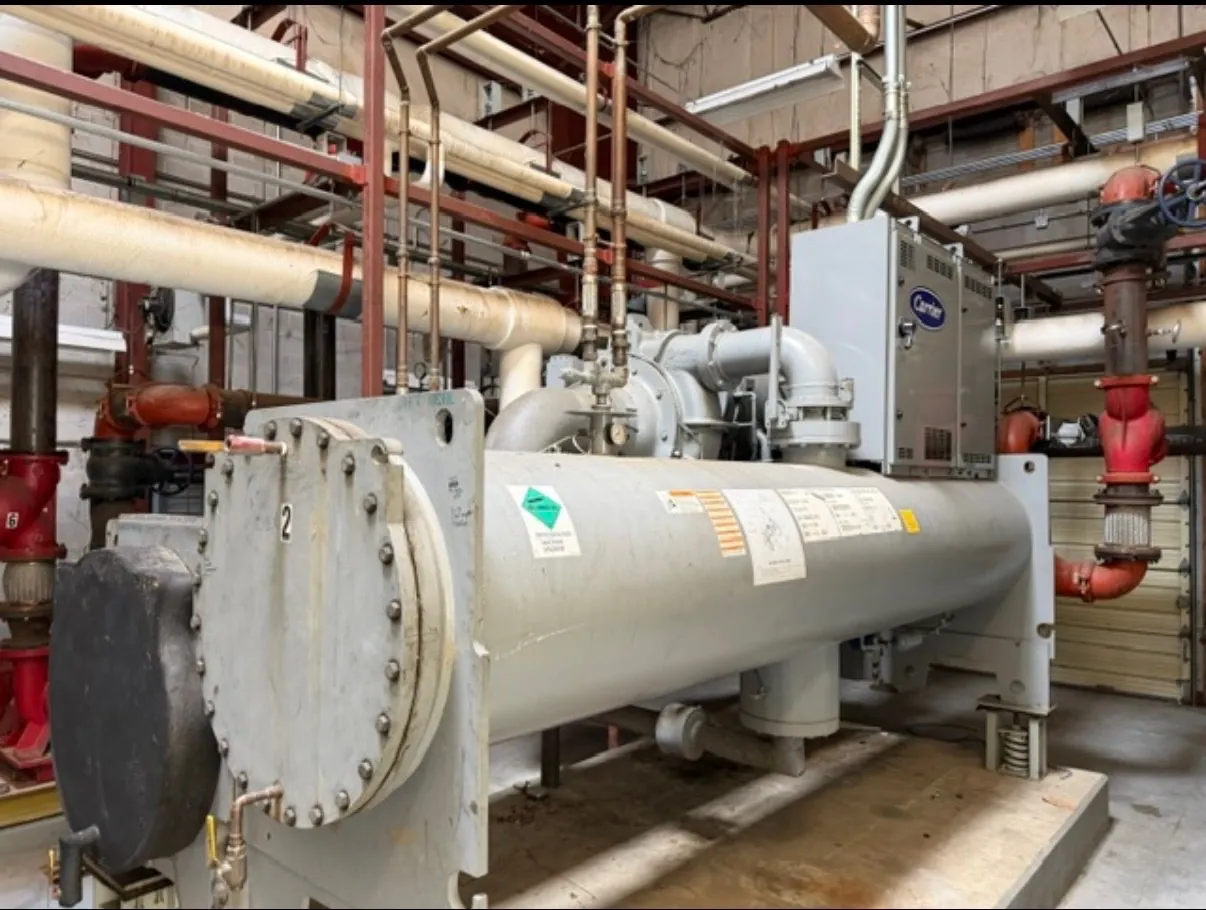
Sell a Surplus Centrifugal Chiller in Clemson, SC
We buy used centrifugal chiller equipment in Clemson and handle the agreed disconnect, rigging, and freight.
We buy chillers. We don’t sell them.
Your chiller.
Our logistics.
Have a surplus or decommissioned chiller? We’re the buyer—here to make moving it straightforward.
From a single unit to equipment from a larger facility, tell us what you have. We buy industrial and commercial chillers across South Carolina and coordinate the work to get them moved.
See how it works
All types & sizes
Air-cooled or water-cooled, centrifugal, screw or scroll. Tell us what you have.
We handle the logistics
We coordinate rigging, refrigerant recovery, loading and freight for the equipment we buy.
Made for sellers
Send the details and nameplate photos to start a conversation about your chiller.
Three steps.
One less chiller.
- 01
Send the details
Share what you know, along with photos of the unit and nameplate.
- 02
Get a quote
We’ll review your equipment and discuss an offer with you.
- 03
Leave the logistics to us
We coordinate removal and freight for the chillers we purchase.
Sell a Surplus Centrifugal Chiller in Clemson, SC
If your Clemson, South Carolina site has a surplus centrifugal chiller, South Carolina Chiller Buyers can consider purchasing it directly. We buy used chillers; we do not sell replacement equipment. A unit may be surplus because operating needs have changed, a project has been revised, or another chiller now carries the required load. Its age or current operating status does not by itself determine whether it can be considered.
When another chiller or a shared system must remain active, removal planning needs to account for both the equipment being sold and the equipment that stays. You do not need to shut down, start, test, repair, or prepare the surplus machine just to request an offer. Share what you know about its configuration, condition, and access so the offer and possible removal arrangements can be assessed without treating assumptions as confirmed facts.
Describe the machine, not just its capacity
A centrifugal chiller uses an impeller-driven compressor, but centrifugal packages that look similar can differ in compressor and motor arrangement, controls, drive, and internal condition. Record the full unit model and identify the compressor and motor layout if that information is available. Photos of the nameplate and exterior can help distinguish one configuration from another.
Capacity is useful context, but tonnage is not the same as transport weight. A high-capacity chiller is not necessarily the heaviest unit to move, and a compact-looking package may still require specialized handling. If you have shipping or equipment records that state dimensions or weight, share them as documented information rather than estimating from capacity alone. We consider all tonnages, including units below 20 tons; 20 to 2,000+ tons is a common range, not a limit.
Show access and lifting details
Photograph the shell ends, motor, starter or drive, and any visible lifting points. Include a wider view that shows nearby walls, doors, overhead obstructions, and the route to the loading area. A large assembled package may need precise clearance checks. Do not assume it can leave through the same opening used by a technician, or that a clear interior aisle provides a workable route for removal.
If the chiller sits near equipment that must stay in service, explain what is shared and what must remain accessible. For example, if a site conditionally relies on a separate chiller or common access corridor, that dependency may affect the workable sequence and schedule. This is planning information, not a request to alter active equipment or interrupt service.
Keep process fluid and refrigerant distinct
Chiller descriptions can refer to more than one fluid. Refrigerant circulates within the refrigeration circuit; process or chilled water may flow through the system serving the building or process. When describing the unit, identify which fluid a record or label refers to if known. Do not infer refrigerant type from a process-fluid connection, and do not open, drain, vent, cut, or dismantle the machine to find out.
We consider all brands and all refrigerants. If records are incomplete, say so and provide the information that is available, such as the make, model, visible labels, or prior documentation. You are not expected to verify refrigerant condition or perform work before requesting an offer.
Plan around the operating system
When another chiller must continue serving a site, the authorized owner or site representative should identify access limits and coordinate any required permissions. That person can explain whether a route crosses an operating area, whether access is restricted, and what coordination is needed before removal. Do not assume the surplus unit is isolated simply because it is no longer the primary machine.
After an agreed purchase, South Carolina Chiller Buyers handles disconnects, necessary refrigerant recovery through appropriately qualified personnel, crane and rigging, loading, hauling, and freight. Freight is covered. The seller does not need to hire a mover or ship the chiller. Removal timing depends on the equipment, access, and agreement, so a specific date should not be assumed before details are reviewed.
Useful information for an initial review
- Full model and available nameplate details
- Compressor and motor arrangement, plus starter or drive information
- Photos of shell ends, lifting points, and the surrounding removal route
- Known operating or storage history, with uncertainties clearly noted
- Any access restrictions or adjacent system that must remain active
Request an offer without preparing the chiller
Send the information you can gather safely; a complete technical file is not required to begin. Do not energize the unit, open panels, drain fluids, vent refrigerant, or dismantle components for photos. The offer depends on the machine and the agreed terms, and the removal schedule is arranged according to the equipment and site conditions. Payment is upfront after an agreed purchase.
Whether your centrifugal chiller is a large assembled package or a smaller unit, South Carolina Chiller Buyers can review it for purchase in Clemson. The owner or authorized site representative remains responsible for permission and coordinating access, while the buyer manages the agreed removal and freight.
Ready to move
your chiller?
Tell us what you know. If you’re unsure of a detail, leave it blank. Nameplate photos are a great place to start.

Request a quote.
Fill out what you can and we’ll be in touch.