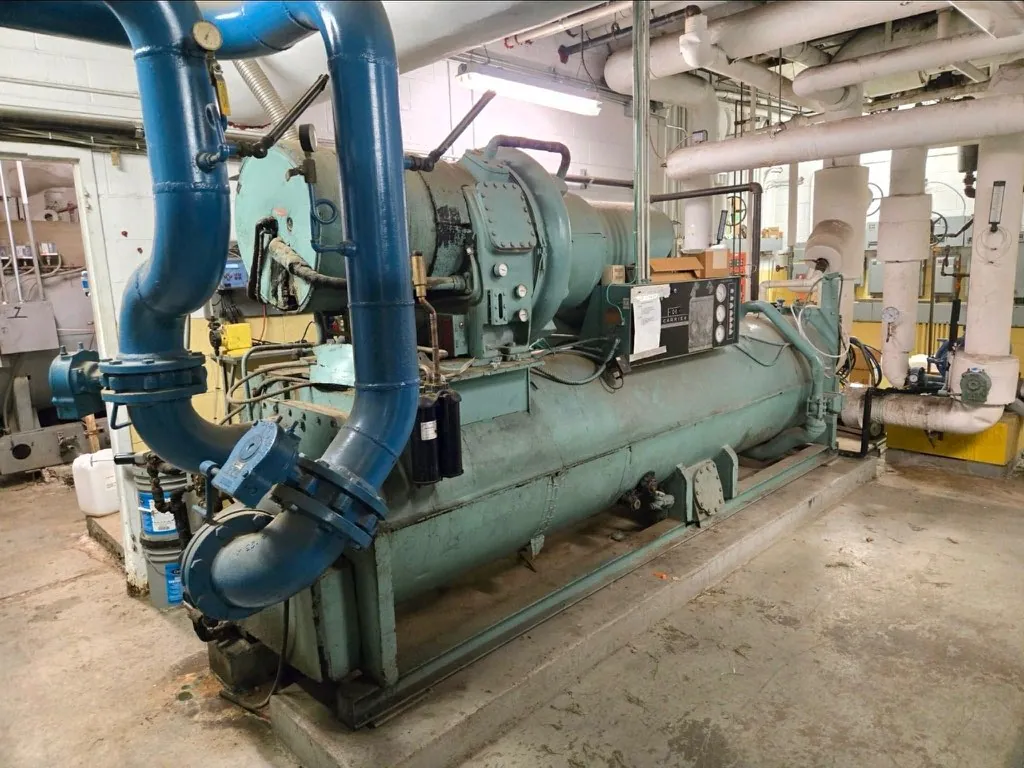
Sell a Chiller Labeled R-22
We consider chillers using R-22 and arrange appropriate recovery and removal in South Carolina.
We buy chillers. We don’t sell them.
Your chiller.
Our logistics.
Have a surplus or decommissioned chiller? We’re the buyer—here to make moving it straightforward.
From a single unit to equipment from a larger facility, tell us what you have. We buy industrial and commercial chillers across South Carolina and coordinate the work to get them moved.
See how it works
All types & sizes
Air-cooled or water-cooled, centrifugal, screw or scroll. Tell us what you have.
We handle the logistics
We coordinate rigging, refrigerant recovery, loading and freight for the equipment we buy.
Made for sellers
Send the details and nameplate photos to start a conversation about your chiller.
Three steps.
One less chiller.
- 01
Send the details
Share what you know, along with photos of the unit and nameplate.
- 02
Get a quote
We’ll review your equipment and discuss an offer with you.
- 03
Leave the logistics to us
We coordinate removal and freight for the chillers we purchase.
Compare the whole purchase scope for an R-22 chiller
If you own a chiller labeled R-22 in South Carolina, comparing offers means looking beyond the price. The purchase scope matters too: who arranges recovery, disconnects, rigging, loading, and freight, and what access the site must provide. South Carolina Chiller Buyers is a direct buyer of used chillers, not a seller of replacement equipment. We consider chillers using all refrigerants, including R-22.
Before deciding which offer fits, confirm what each buyer is proposing to purchase and which removal responsibilities are included. A higher figure may come with more work or expense left to the owner; a lower one may cover a broader removal scope. Ask for the terms in writing so you can compare the agreed price, responsibilities, access requirements, and schedule on the same basis.
What the R-22 label can—and cannot—tell you
R-22 may appear on an older equipment label or in service logs. That information helps describe the chiller, but it does not establish its complete history or current contents. Tell us if you know of a conversion, previous refrigerant recovery, or missing documentation. Uncertainty is useful context for evaluating the equipment; it is not a reason to open the circuit, test the unit, or release refrigerant.
Refrigerant is only one part of an assessment. Make, model, rated capacity, condition, and removal access also affect an offer and the practical removal plan. A nameplate entry can help identify a unit, but it does not by itself determine its purchase value or what lifting and transport will require.
Capacity is not transport weight
Chiller capacity is commonly stated in tons as a measure of cooling output. It is not the machine’s shipping weight. Transport planning depends on the equipment’s physical dimensions and weight, the route out of the building or compound, and the available space for lifting and loading. If weight or dimensions are unknown, share what you can identify and describe any access constraints; do not dismantle equipment to obtain measurements.
We consider chillers of all tonnages, including units below 20 tons. A range of 20 to 2,000+ tons is common, but it is not a minimum or a maximum eligibility rule. A smaller chiller may still be worth discussing, and a larger rating does not guarantee a particular offer or removal arrangement.
Common R-22 equipment is not a list of exclusions
An R-22 label can be found on different kinds of chiller equipment, including water-cooled and air-cooled arrangements. These are examples of equipment types, not a promise that a particular configuration will be purchased under identical terms. We consider all brands and refrigerants. Make, model, capacity, condition, and removal circumstances help determine whether an offer is appropriate.
If records are incomplete, provide the information available without guessing. A readable label, existing service paperwork, or a brief description of the unit may help identify it. Do not energize the chiller, open its refrigerant circuit, drain it, or cut or dismantle anything for an inquiry.
Check removal responsibilities before accepting
For an agreed purchase, the buyer handles disconnects, necessary refrigerant recovery through appropriately qualified personnel, crane and rigging, loading, hauling, and freight. Freight is covered. A seller is not asked to test, start, repair, or prepare the chiller to request an offer, and should not handle or vent R-22. The authorized owner or site representative must still authorize the transaction and coordinate access.
Access details can change what removal requires. For example, if a unit is behind a restricted entrance or in a space with limited lifting clearance, that could affect the rigging plan and schedule. Describe known conditions and site requirements; the specific plan depends on the equipment and the agreement. The seller does not need to hire a carrier or ship the chiller.
Information that helps make an offer comparable
When requesting an offer, provide the equipment details you have and identify uncertainties plainly. There is no need to prepare or operate the chiller first. These details can help distinguish a refrigerant question from a capacity, condition, or access question:
- Make, model, rated tonnage, and any available equipment-label information.
- Whether records show an R-22 conversion, prior recovery, or gaps in documentation.
- Known condition and whether the unit is installed, without attempting a test or repair.
- Access limits, lifting considerations, and who can authorize entry and coordinate removal.
Agree on scope, payment, and timing
South Carolina Chiller Buyers pays upfront for an agreed purchase. The amount and removal schedule depend on the chiller and the terms reached; neither should be assumed from the refrigerant label or tonnage alone. Before accepting, confirm the agreed equipment, payment terms, included removal responsibilities, access coordination, and the schedule. This gives an owner a practical basis for comparing purchase scopes—not just headline prices—when selling an R-22 chiller in South Carolina.
Ready to move
your chiller?
Tell us what you know. If you’re unsure of a detail, leave it blank. Nameplate photos are a great place to start.

Request a quote.
Fill out what you can and we’ll be in touch.