Sell a Surplus Air-Cooled Chiller in Mullins, SC
We buy used air-cooled chiller equipment in Mullins and handle the agreed disconnect, rigging, and freight.
We buy chillers. We don’t sell them.
Your chiller.
Our logistics.
Have a surplus or decommissioned chiller? We’re the buyer—here to make moving it straightforward.
From a single unit to equipment from a larger facility, tell us what you have. We buy industrial and commercial chillers across South Carolina and coordinate the work to get them moved.
See how it works
All types & sizes
Air-cooled or water-cooled, centrifugal, screw or scroll. Tell us what you have.
We handle the logistics
We coordinate rigging, refrigerant recovery, loading and freight for the equipment we buy.
Made for sellers
Send the details and nameplate photos to start a conversation about your chiller.
Three steps.
One less chiller.
- 01
Send the details
Share what you know, along with photos of the unit and nameplate.
- 02
Get a quote
We’ll review your equipment and discuss an offer with you.
- 03
Leave the logistics to us
We coordinate removal and freight for the chillers we purchase.
Sell a Surplus Air-Cooled Chiller in Mullins, SC
If you have an air-cooled chiller in Mullins that is no longer needed, South Carolina Chiller Buyers considers it for purchase. The company is a direct buyer, not a seller of replacement equipment. Surplus units can be worth reviewing even when their operating history is incomplete, their labels are hard to read, or they have not been run recently.
Air-cooled chillers reject heat through outdoor coils and fans instead of using a conventional cooling-tower loop. That distinction helps describe the equipment, but it does not establish its condition or value. Share what you can verify; do not guess at capacity, refrigerant, operating status, or modifications.
Use the nameplate as a starting point, not a verdict
Older nameplates may be faded, painted over, obscured by guards, or missing. If the label is readable from a safe, accessible position, a clear photograph can help identify the manufacturer, model, serial number, nominal capacity, and refrigerant designation. If a detail cannot be confirmed, mark it as unknown rather than filling in a likely answer.
Chiller capacity is not the same as transport weight. A tonnage figure describes cooling capacity; it does not tell a removal crew how heavy the complete unit is or how it can be lifted. South Carolina Chiller Buyers considers units of all tonnages, including below 20 tons, with 20 to 2,000-plus tons being a common range. No particular capacity alone guarantees an offer.
Describe what is visible without testing the unit
You do not need to start, test, repair, open, drain, or dismantle the chiller to request an offer. Avoid energizing equipment just to obtain information, and do not disturb refrigerant lines or electrical connections. From a safe viewpoint, useful observations include the apparent condition of the outdoor coils, whether fan assemblies appear present, and the number of compressors if they are visible without opening the machine.
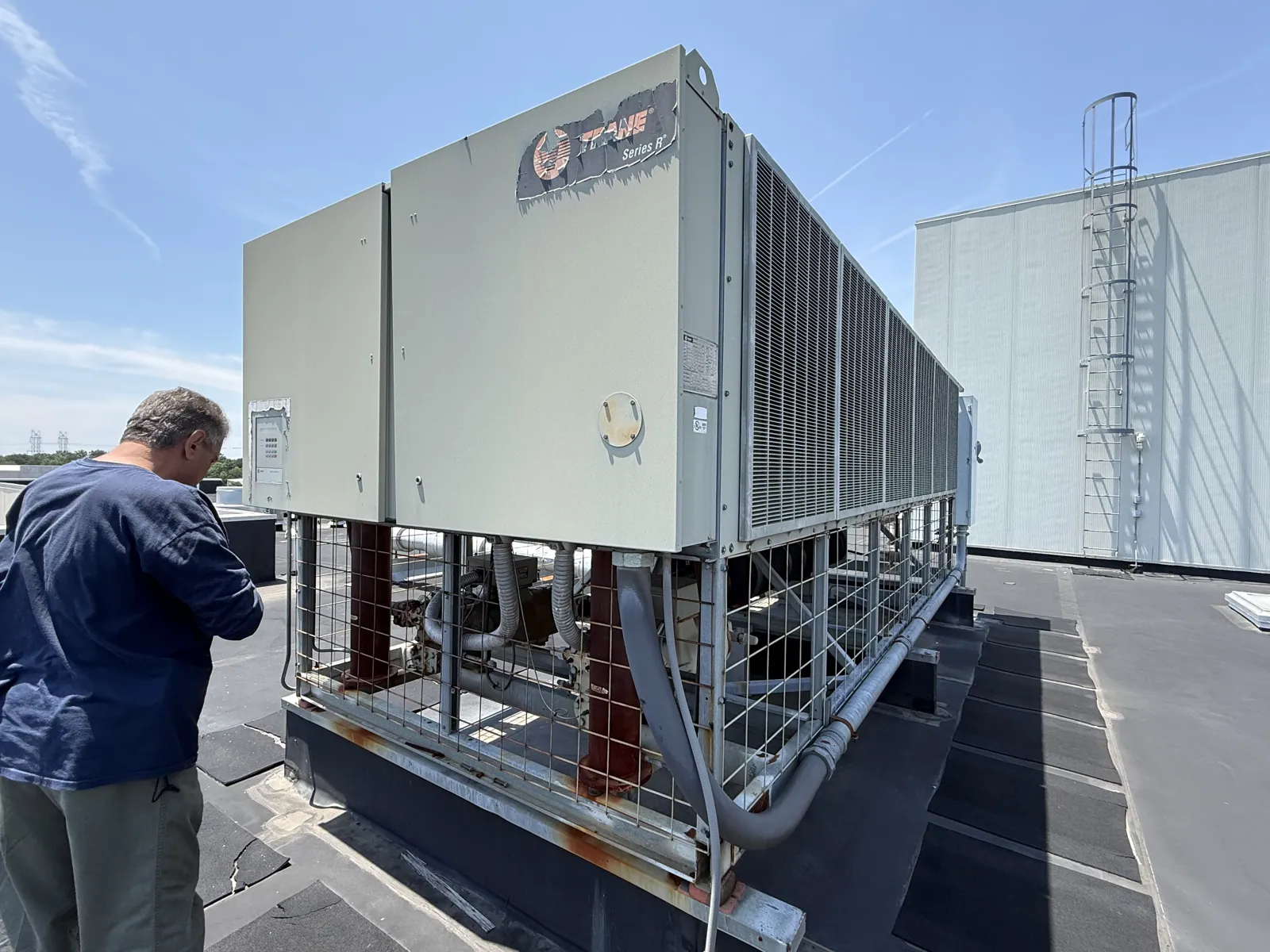
Note whether the unit sits on a roof, a ground-level pad, or a raised frame. A photo of the complete installation and nearby access can be more useful than a close-up alone. If the label is unreadable or the machine is partly obstructed, say so plainly; uncertainty is better than an invented specification.
Look for records that clarify retrofits
Available service or project records may explain changes made after the original manufacture date. For example, a conditional case might involve a replacement compressor or a refrigerant conversion documented in an old work order. Such records can help distinguish original nameplate information from later changes, but they do not prove the chiller’s present condition.
Do not infer the current refrigerant from the unit’s age, appearance, or a similar model. If records identify a retrofit, provide the document or describe what it says and when it was prepared. If no paperwork is available, report that too. All brands and refrigerants are considered, so an uncertain or changed refrigerant is not a reason to invent an answer.
Removal planning depends on the installation
A rooftop or elevated air-cooled chiller may need a lift plan and a protected area at ground level for the operation. At grade, the route from the machine to a truck still matters: gates, turns, overhead obstructions, soft ground, and limited clearance may affect removal planning. Share photographs of the surrounding space when practical, without moving barriers or equipment to create access.
Unit capacity does not determine the full transport challenge. Dimensions, configuration, lifting access, and the path out of the site all matter. The buyer assesses removal arrangements with the equipment and agreed scope in mind rather than promising that every installation can be handled on the same schedule.
What happens after an agreed purchase
Payment is upfront. After a purchase is agreed, South Carolina Chiller Buyers handles disconnects, necessary refrigerant recovery through appropriately qualified personnel, crane and rigging, loading, hauling, and freight; freight is covered. The authorized owner or site representative must still give permission and coordinate site access. Sellers do not need to arrange shipping or hire a removal contractor for the transaction.
The offer and removal schedule depend on the chiller, the information available, access conditions, and the agreement. An initial description is a basis for review, not a guaranteed price or removal date.
Prepare a clear request
For your air-cooled chiller in Mullins, provide the information you can confirm and identify anything you cannot. A concise request can include:
- Readable nameplate photos, or a note that the label is missing or illegible.
- Visible fan, coil, and compressor details, without operating or opening the unit.
- Any available retrofit or service records, especially documents naming a refrigerant change.
- Installation type and photos of the route, gates, clearance, and overhead conditions.
These details help the buyer assess the equipment and removal requirements without asking you to prepare the chiller. Share only what is safe and accessible, and let the buyer follow up on unknowns before an agreement is made.
Ready to move
your chiller?
Tell us what you know. If you’re unsure of a detail, leave it blank. Nameplate photos are a great place to start.

Request a quote.
Fill out what you can and we’ll be in touch.