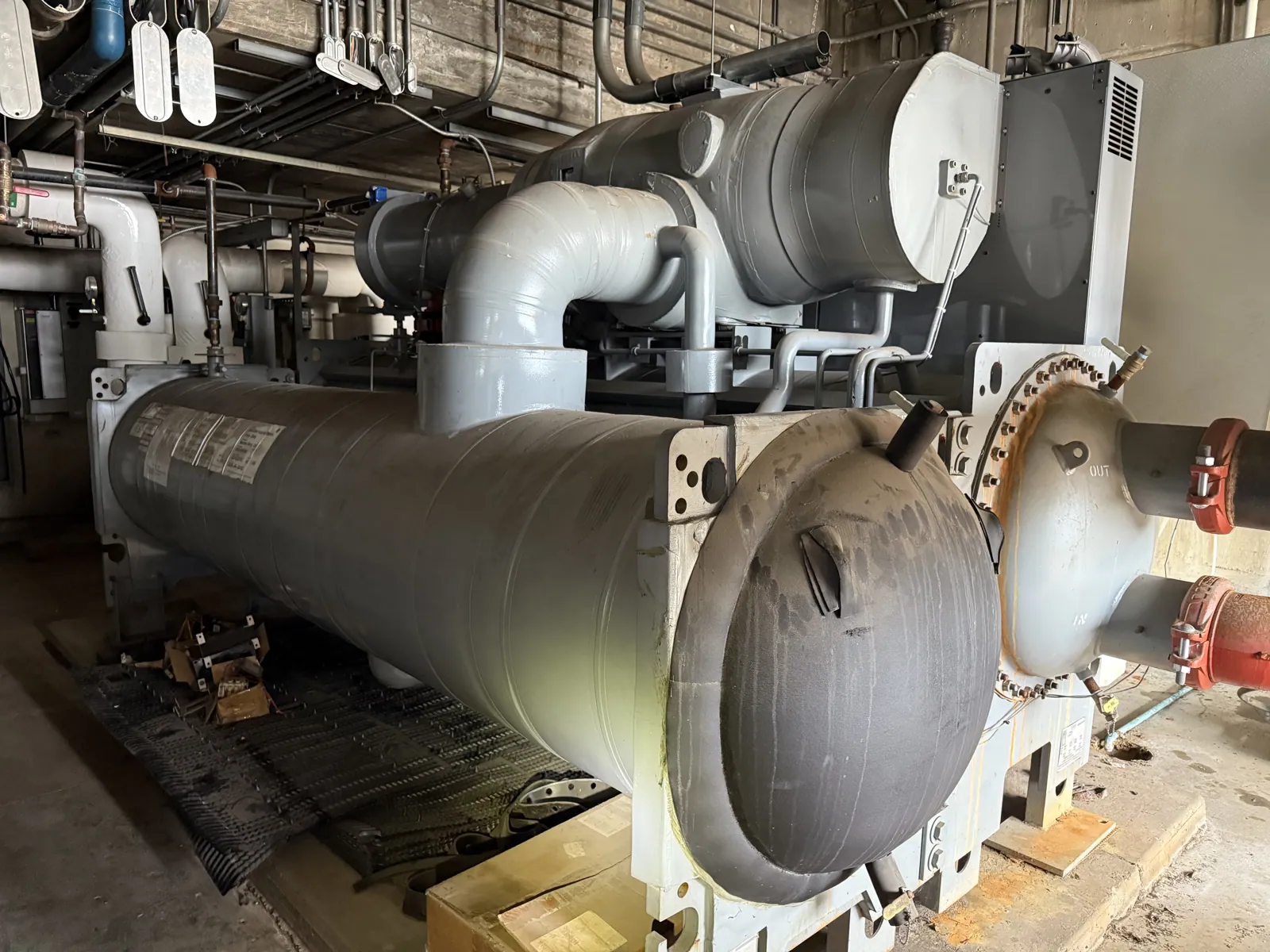
Sell a Surplus Water-Cooled Chiller in Lexington, SC
We buy used water-cooled chiller equipment in Lexington and handle the agreed disconnect, rigging, and freight.
We buy chillers. We don’t sell them.
Your chiller.
Our logistics.
Have a surplus or decommissioned chiller? We’re the buyer—here to make moving it straightforward.
From a single unit to equipment from a larger facility, tell us what you have. We buy industrial and commercial chillers across South Carolina and coordinate the work to get them moved.
See how it works
All types & sizes
Air-cooled or water-cooled, centrifugal, screw or scroll. Tell us what you have.
We handle the logistics
We coordinate rigging, refrigerant recovery, loading and freight for the equipment we buy.
Made for sellers
Send the details and nameplate photos to start a conversation about your chiller.
Three steps.
One less chiller.
- 01
Send the details
Share what you know, along with photos of the unit and nameplate.
- 02
Get a quote
We’ll review your equipment and discuss an offer with you.
- 03
Leave the logistics to us
We coordinate removal and freight for the chillers we purchase.
Sell a Surplus Water-Cooled Chiller in Lexington, SC
South Carolina Chiller Buyers purchases surplus water-cooled chillers in Lexington, South Carolina. We are a direct buyer, not a seller of replacement equipment. We consider all tonnages, including units below 20 tons; 20 to 2,000+ tons is a common range. We review all brands and refrigerants, so an old nameplate, an unfamiliar model, or a refrigerant that is no longer in routine use is not by itself a reason to rule out an offer.
Start with what you can identify without disturbing the equipment. A clear view of the nameplate, overall unit, surrounding connections, and access route can help describe the chiller. If a label is faded, missing, or inconsistent with newer records, report that uncertainty rather than filling in a guessed capacity, model, or refrigerant.
Trace Both Water Circuits Before Describing the Scope
A water-cooled chiller normally interfaces with two separate water systems: a chilled-water loop serving the building or process, and a condenser-water loop that typically connects to heat-rejection equipment. Do not treat them as one set of pipes when discussing removal. Identify which connections appear to serve each circuit, and note whether the cooling tower, pumps, controls, and related equipment are included in the sale or will remain at the property.
Those boundaries matter if other equipment is still operating. For example, if a chiller shares headers with a unit that must remain in service, photographs showing pipe runs and nearby valves may help the parties understand the intended separation. They do not establish that a line can safely be disconnected; that determination belongs to qualified site personnel working under the agreed removal plan.
Use Records to Clarify an Old or Modified Unit
Older equipment may have original labels alongside later retrofit records, service notes, or replacement control components. These documents can describe changes made over time, but they may not match every part of the present installation. Share available records as records, including their dates and any visible qualifications. Avoid assuming that a retrofit changed the chiller’s full capacity, refrigerant, or operating configuration unless reliable documentation supports that conclusion.
If the nameplate and paperwork disagree, flag the mismatch and provide images of both. A conditional example: a record might identify a refrigerant conversion while a label still shows the original charge type. That discrepancy is useful to disclose, not a reason to select one version by guesswork. The buyer can review the information with the rest of the equipment details before making an offer.
Describe the Chiller, Not Just Its Tonnage
Capacity and transport weight answer different questions. Tonnage describes cooling capacity; it does not tell a rigger how heavy the equipment is or whether it will fit through the machinery-room exit. If available, share the unit’s dimensions, shipping or operating weight from documentation, and any known access limitations. Do not infer a transport weight from tonnage alone.
Useful photos for water-cooled chiller removal include the nameplate, the complete unit, valves and insulation near both water circuits, visible pipe routes, and the exit path from the machinery room. Include tight turns, door clearances, overhead obstructions, or other constraints that can be seen. Photos help establish scope, but they do not replace access coordination or a site-specific rigging plan.
Make the Sale Boundary Clear
Tell us what is part of the surplus equipment and what stays with the property. A chiller may be offered by itself, or the agreed purchase may include associated controls or other components. The cooling tower, pumps, piping, and building controls should not be presumed included merely because they are connected to the system. Written clarity about these boundaries helps avoid confusion during planning.
South Carolina Chiller Buyers handles the removal work after an agreed purchase, including disconnects, refrigerant recovery through appropriately qualified personnel, crane and rigging, loading, hauling, and freight. Freight is covered. The authorized owner or site representative must still provide permission and coordinate access. Sellers do not need to test, start, repair, drain, or prepare the unit to request an offer.
What to Share When Requesting an Offer
- Brand, model, serial number, and capacity if legible; mark uncertain details as unknown.
- Any available retrofit or service records, with apparent conflicts noted rather than resolved by assumption.
- Photos of both water-circuit connections, nearby piping, equipment included or excluded, and the machinery-room exit.
- Known access conditions and the name or role of the authorized person who can coordinate site entry.
Offer and Removal Timing Depend on the Agreement
Send the information you can verify, even if some labels are unreadable or records are incomplete. The offer depends on the equipment and the agreed purchase terms; the removal schedule depends on the equipment, access, and agreement as well. No specific price or date should be assumed before those details are reviewed. Once the purchase is agreed, payment is upfront and the buyer coordinates the removal scope with the authorized site representative.
For your water-cooled chiller in Lexington, accurate boundaries and candid uncertainty are more useful than a confident guess. Share what is known, identify what remains unclear, and leave disconnection and equipment handling to the qualified personnel assigned under the agreed plan.
Ready to move
your chiller?
Tell us what you know. If you’re unsure of a detail, leave it blank. Nameplate photos are a great place to start.

Request a quote.
Fill out what you can and we’ll be in touch.