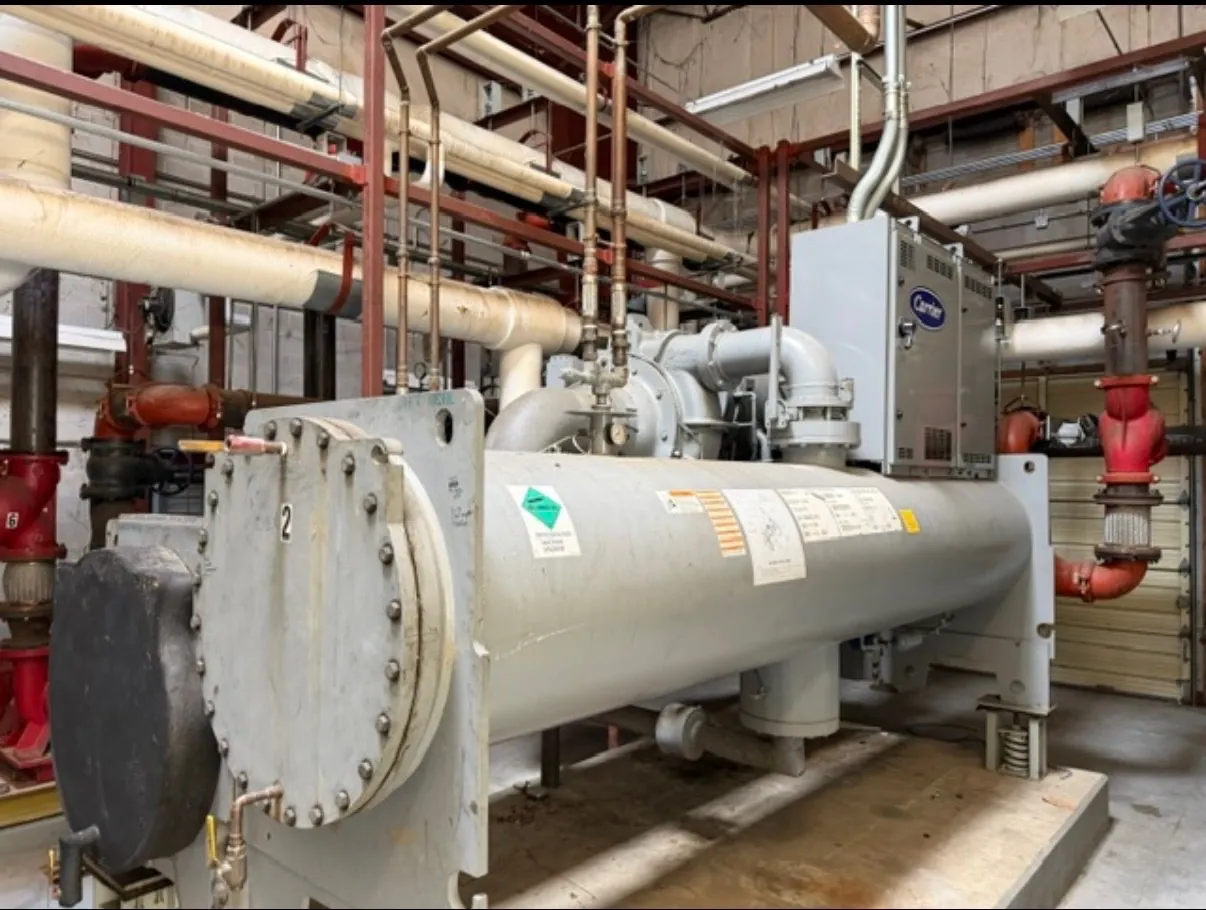
Sell a Surplus Centrifugal Chiller in Fountain Inn, SC
We buy used centrifugal chiller equipment in Fountain Inn and handle the agreed disconnect, rigging, and freight.
We buy chillers. We don’t sell them.
Your chiller.
Our logistics.
Have a surplus or decommissioned chiller? We’re the buyer—here to make moving it straightforward.
From a single unit to equipment from a larger facility, tell us what you have. We buy industrial and commercial chillers across South Carolina and coordinate the work to get them moved.
See how it works
All types & sizes
Air-cooled or water-cooled, centrifugal, screw or scroll. Tell us what you have.
We handle the logistics
We coordinate rigging, refrigerant recovery, loading and freight for the equipment we buy.
Made for sellers
Send the details and nameplate photos to start a conversation about your chiller.
Three steps.
One less chiller.
- 01
Send the details
Share what you know, along with photos of the unit and nameplate.
- 02
Get a quote
We’ll review your equipment and discuss an offer with you.
- 03
Leave the logistics to us
We coordinate removal and freight for the chillers we purchase.
Sell a Surplus Centrifugal Chiller in Fountain Inn, SC
If you have a surplus centrifugal chiller in Fountain Inn, South Carolina, a useful first step is to turn scattered records and observations into a clear equipment inventory. South Carolina Chiller Buyers purchases used chillers directly; we do not sell replacement equipment. You can request an offer without first testing, starting, repairing, or preparing the chiller.
Inventory does not need to be perfect to begin a conversation. The goal is to identify what is present, what is known, and what still needs confirmation. That distinction helps keep the purchase discussion grounded in the actual machine rather than assumptions based on its size or appearance.
Identify the Machine Beyond Its Exterior
A centrifugal chiller uses an impeller-driven compressor. Record the complete unit model and any readable compressor and motor identification, including how the compressor and motor are arranged. Packages that look much alike can differ in controls, drive configuration, and internal condition, so a cabinet photograph alone may not tell the full story.
Gather existing nameplate images, service records, drawings, or asset-list entries if they are readily available. Note whether information comes from a physical label, an old document, or someone’s recollection. If a plate is obscured or unreadable, mark that as unknown instead of trying to access it by opening or dismantling equipment.
Build a Practical Condition Record
Describe what is already known without attempting to prove that the chiller operates. For example, an owner might have a shutdown record and a recent service report but no current operating data. That can still support an initial review; make clear that the machine has not been recently run rather than implying a confirmed operating condition.
Separate the chiller’s refrigerant from any process fluid in the system. Refrigerant is part of the chiller circuit, while process fluid—often water or another heat-transfer fluid—serves the connected process or building loop. Records may identify one without establishing the status of the other. Do not drain, vent, open, or otherwise disturb either circuit to complete an inventory.
Describe Size Without Confusing Capacity and Weight
Capacity, commonly expressed in tons, describes cooling capacity; it is not the shipping weight. South Carolina Chiller Buyers considers chillers of all tonnages, including units below 20 tons. A range of 20 to 2,000-plus tons is common, but neither a small rating nor a large one by itself determines whether a unit is a fit for purchase.
Transport planning depends on the physical package and its route out of the site, not just the tonnage. If weight is available from a drawing or equipment record, share its source. If it is not known, say so. Do not estimate lifting weight from capacity or assume that a compact-looking enclosure is easy to move.
Document the Package and Its Exit Route
Photograph the shell ends, motor, starter or drive, and any visible lifting points from safe, accessible positions. A large assembled package may need careful clearance measurements. The opening used by a technician to enter a room is not necessarily wide or tall enough for the complete chiller to pass through.
If you can gather measurements without moving equipment or entering an unsafe area, record the relevant doorway or access dimensions and note turns, overhead restrictions, or changes in floor level. For instance, if the machine sits behind a narrow service corridor, flag that constraint early; the removal approach would depend on the actual route and agreed scope. Do not cut, dismantle, or rearrange equipment to create an exit.
Turn Incomplete Notes Into a Useful Request
A concise inventory can include the manufacturer and model, compressor and motor arrangement, approximate capacity, available condition records, refrigerant information if documented, photographs, known dimensions, and access concerns. Mark each item as confirmed, estimated, or unknown. This makes gaps visible without delaying an initial request for information that may be difficult or unsafe to obtain.
- Share existing records and safe, current photographs.
- Identify missing details rather than guessing.
- Describe access limits and the authorized site contact.
All brands and refrigerants are considered. The offer and removal schedule depend on the equipment and the purchase agreement, so neither a particular price nor a specific date can be assumed before review.
Understand What Happens After Agreement
Payment is upfront. Once a purchase is agreed, South Carolina Chiller Buyers handles disconnects, necessary refrigerant recovery through appropriately qualified personnel, crane and rigging, loading, hauling, and freight. Freight is covered. The seller does not need to hire a carrier or ship the chiller.
The authorized owner or site representative must still approve the transaction and coordinate access. That person can help confirm site requirements and arrange a suitable removal window with the buyer. For a surplus centrifugal chiller in Fountain Inn, a candid inventory—complete or not—gives both sides a practical basis to discuss the equipment and the work required to remove it.
Ready to move
your chiller?
Tell us what you know. If you’re unsure of a detail, leave it blank. Nameplate photos are a great place to start.

Request a quote.
Fill out what you can and we’ll be in touch.