Sell a Surplus Centrifugal Chiller in Conway, SC
We buy used centrifugal chiller equipment in Conway and handle the agreed disconnect, rigging, and freight.
We buy chillers. We don’t sell them.
Your chiller.
Our logistics.
Have a surplus or decommissioned chiller? We’re the buyer—here to make moving it straightforward.
From a single unit to equipment from a larger facility, tell us what you have. We buy industrial and commercial chillers across South Carolina and coordinate the work to get them moved.
See how it works
All types & sizes
Air-cooled or water-cooled, centrifugal, screw or scroll. Tell us what you have.
We handle the logistics
We coordinate rigging, refrigerant recovery, loading and freight for the equipment we buy.
Made for sellers
Send the details and nameplate photos to start a conversation about your chiller.
Three steps.
One less chiller.
- 01
Send the details
Share what you know, along with photos of the unit and nameplate.
- 02
Get a quote
We’ll review your equipment and discuss an offer with you.
- 03
Leave the logistics to us
We coordinate removal and freight for the chillers we purchase.
Sell a Surplus Centrifugal Chiller in Conway, SC
South Carolina Chiller Buyers purchases surplus centrifugal chillers in Conway, South Carolina. We are a direct buyer, not a seller of replacement equipment. If a facility has several similar chillers, identifying the particular machine available for sale is an important first step: packages that look alike may differ in capacity, compressor and motor arrangement, controls, drive, or condition.
We consider centrifugal chillers of all tonnages, including units below 20 tons; 20 to 2,000+ tons is a common range. We consider all brands and refrigerants. An older, idle, or untested machine can still be described for an offer request. You do not need to start, test, repair, or prepare it.
Identify the exact machine before requesting an offer
When a site has multiple chillers, avoid relying on a general description such as “the west plant unit” or “the 500-ton chiller.” First match the available nameplate information to the specific package under consideration. Record the full unit model and, if accessible without disturbing the equipment, the serial number. Note the compressor and motor arrangement as well: centrifugal machines use an impeller-driven compressor, but their drive and motor configurations can vary.
Keep the identifying details tied to one machine. For example, if a facility has two visually similar packages and only one is surplus, label the photos and notes with a consistent equipment tag or location description. That helps prevent the model number from one chiller being paired with photos of another. Do not enter restricted areas or remove covers to find information; use records and details that are safely available.
Useful records and photographs
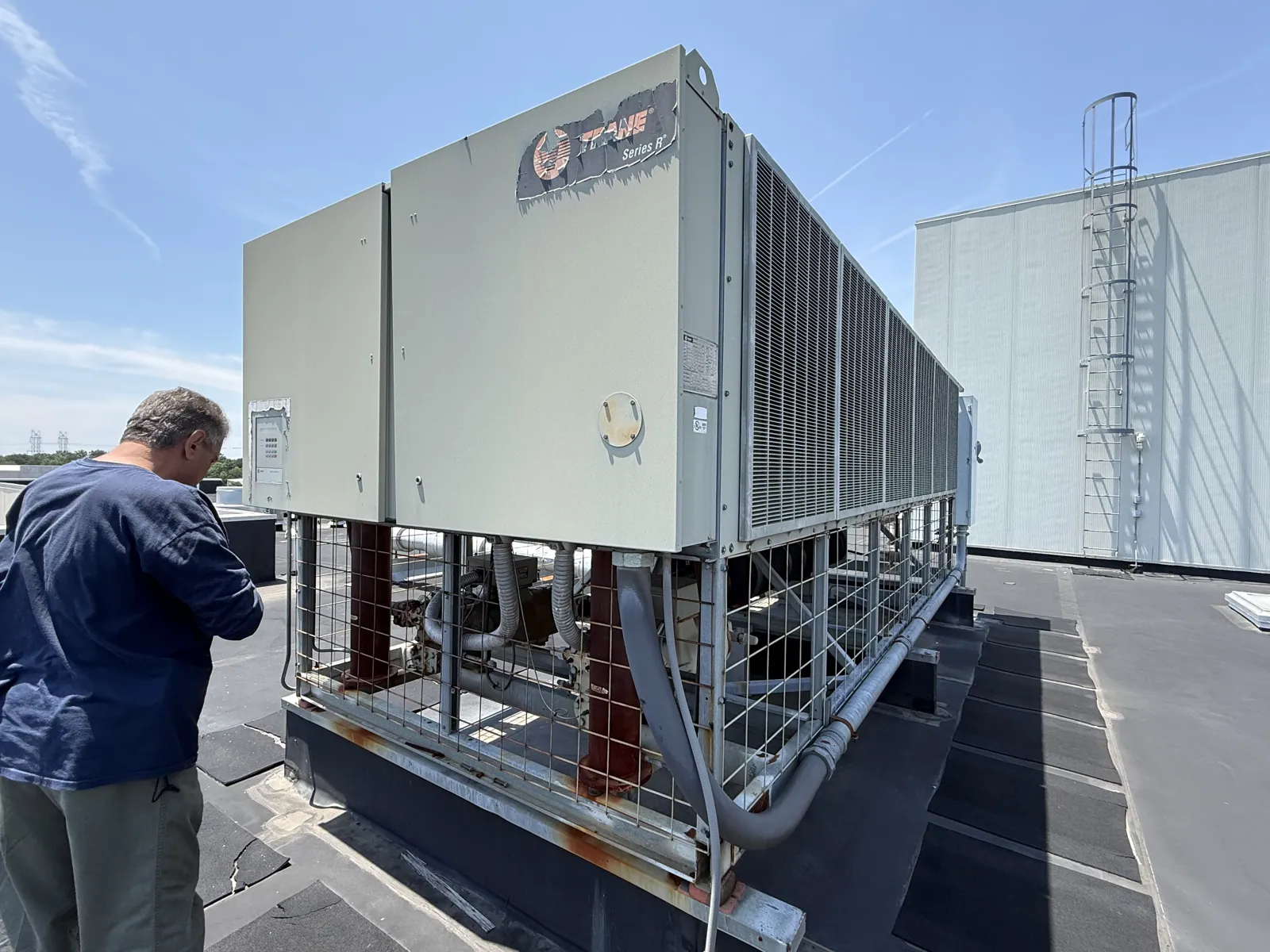
Share the unit model, known tonnage, brand, refrigerant if known, and any available service or inventory records. Clearly mark estimates or unknown items rather than guessing. A photograph of the nameplate can help distinguish near-matching packages, while a wider image can show which unit is being offered and its position relative to nearby equipment.
Photograph the shell ends, motor, starter or drive, and any visible lifting points from safe, authorized locations. For a large assembled package, record approximate route clearances and the dimensions of relevant openings. Do not assume the chiller can pass through the same opening used for technician access: a doorway or hatch may be too small for the complete package, and the removal route may include turns or overhead restrictions.
Capacity is not transport weight
Chiller tonnage describes cooling capacity; it does not tell a mover how heavy or difficult the machine will be to handle. Transport planning depends on the assembled unit’s dimensions and weight, configuration, access route, and available lifting points. If reliable shipping or equipment records give dimensions or weight, include them. If those figures are unavailable, say so rather than treating capacity as a substitute.
Likewise, distinguish the chiller’s refrigerant from any process fluid associated with the system. They are different materials with different handling needs. Do not drain, vent, disconnect, cut, or dismantle equipment to gather information. After an agreed purchase, necessary refrigerant recovery is handled by appropriately qualified personnel as part of the buyer’s removal work.
What happens after an agreed purchase
After the purchase terms are agreed, South Carolina Chiller Buyers handles the disconnects, necessary refrigerant recovery through appropriately qualified personnel, crane and rigging, loading, hauling, and freight. Freight is covered. The seller does not need to hire a rigging crew or arrange shipment.
The authorized owner or site representative must still approve the sale and coordinate access. That may include confirming site procedures, arranging an access window, and identifying any restrictions that affect equipment movement. The offer and removal schedule depend on the particular chiller, site access, and agreed terms; neither a price nor a removal date can be promised in advance.
When a surplus unit may be worth discussing
A facility could have several similar chillers but need to retain only the machines required for its operating plan. If one package is designated surplus, identify it precisely and provide its records separately from those for the units staying in service. In another situation, a machine may be idle while a site evaluates a change in use. It can still be described for consideration without being energized or repaired for an offer request.
These are illustrative situations, not assumptions about any particular Conway property. The practical decision is whether the exact unit can be identified, whether the owner can authorize its sale, and whether access and removal can be coordinated. South Carolina Chiller Buyers will consider the equipment details and discuss an offer based on the machine and the agreement.
Prepare a clear request
- Identify the specific chiller with its full model and available serial number.
- Describe its compressor and motor arrangement, known capacity, and known refrigerant.
- Provide safe photographs of the shell ends, motor, starter or drive, lifting points, and surrounding access.
- Share known dimensions, weight, records, and access constraints, marking unknown details clearly.
- Confirm that an authorized owner or site representative can approve the sale and coordinate access.
With a well-matched set of details and photos, it is easier to assess a surplus centrifugal chiller without confusing it with a neighboring unit. No testing, startup, repair, or dismantling is required simply to request an offer.
Ready to move
your chiller?
Tell us what you know. If you’re unsure of a detail, leave it blank. Nameplate photos are a great place to start.

Request a quote.
Fill out what you can and we’ll be in touch.