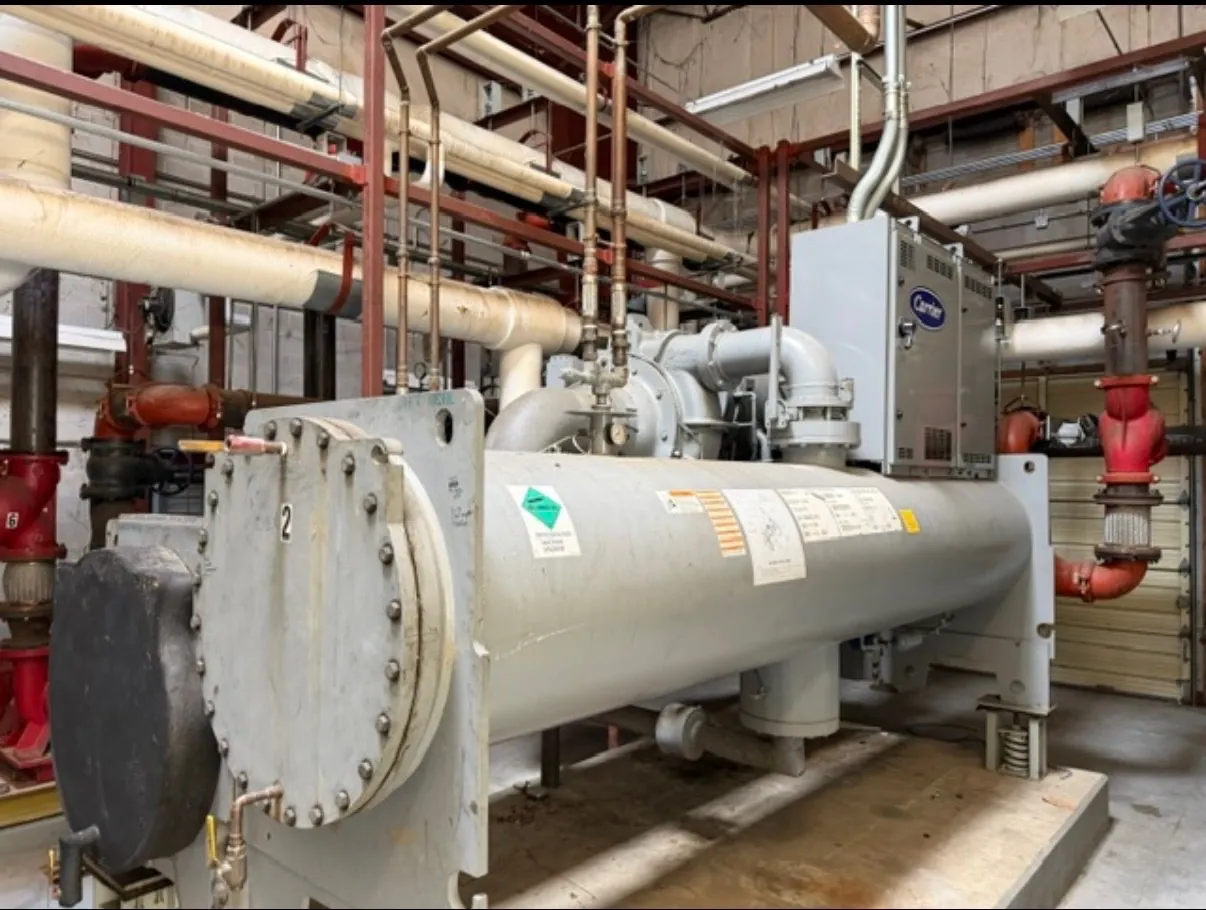
Sell a Surplus Centrifugal Chiller in Bishopville, SC
We buy used centrifugal chiller equipment in Bishopville and handle the agreed disconnect, rigging, and freight.
We buy chillers. We don’t sell them.
Your chiller.
Our logistics.
Have a surplus or decommissioned chiller? We’re the buyer—here to make moving it straightforward.
From a single unit to equipment from a larger facility, tell us what you have. We buy industrial and commercial chillers across South Carolina and coordinate the work to get them moved.
See how it works
All types & sizes
Air-cooled or water-cooled, centrifugal, screw or scroll. Tell us what you have.
We handle the logistics
We coordinate rigging, refrigerant recovery, loading and freight for the equipment we buy.
Made for sellers
Send the details and nameplate photos to start a conversation about your chiller.
Three steps.
One less chiller.
- 01
Send the details
Share what you know, along with photos of the unit and nameplate.
- 02
Get a quote
We’ll review your equipment and discuss an offer with you.
- 03
Leave the logistics to us
We coordinate removal and freight for the chillers we purchase.
Sell a Surplus Centrifugal Chiller in Bishopville, SC
South Carolina Chiller Buyers purchases surplus centrifugal chillers in Bishopville and throughout South Carolina. We are a direct buyer, not a seller of replacement equipment. If a plant change, building conversion, or discontinued cooling requirement leaves your centrifugal chiller unused, you can request an offer without first making it operational or preparing it for shipment.
We consider all tonnages, including chillers below 20 tons; 20 to 2,000+ tons is a common range. We also consider all brands and refrigerants. Whether your unit is intact, out of service, or of uncertain condition, share what is known so we can assess the specific equipment. An offer and removal schedule depend on the chiller, site conditions, and the terms agreed upon; neither a particular price nor a specific date can be promised in advance.
Identify the Machine Beyond Its Capacity
A centrifugal chiller uses an impeller-driven compressor, but capacity alone does not identify the package or establish its value. Record the full unit model and, when available, the compressor and motor arrangement. Two machines that look alike from the outside may have materially different controls, drives, or internal condition. Nameplate information, existing records, and clear photographs can help distinguish them.
Useful views include the shell ends, motor, starter or drive, and any visible lifting points. Include overall shots that show how the package sits in the room. Do not open panels or access internal components to gather details; use information already visible or available in site records. If the unit’s history is incomplete, say so rather than guessing at its condition.
Capacity Is Not Transport Weight
Tonnage describes cooling capacity, not the weight or dimensions of the equipment that must be removed. Transport planning depends on the assembled package, its configuration, the route out, and the lifting and loading conditions. A high-capacity chiller may have substantial transport demands, while a smaller unit can still be difficult to move if its route has tight turns or restricted headroom.
Photograph the route and note known door, corridor, ceiling, and turning clearances. Also note any available lifting points, without assuming that a visible feature is suitable for a lift. A large assembled package may need careful clearance review: the opening used by a technician may not be large enough for the chiller to pass through. If removal might require a different route or access arrangement, describe the constraint before a schedule is set.
When a Mechanical Room Has a Narrow Exit
For example, if a Bishopville site has a centrifugal chiller in a mechanical room with a narrow doorway, the practical question is not simply whether the machine can be lifted. The full route may include a low overhead, a tight turn, or a passage that cannot accommodate the package as assembled. Share measurements that are already available and photographs of the route so the removal plan can be considered against the actual access conditions.
This is a conditional planning example, not a claim about any particular building. Do not attempt to dismantle the chiller, remove doors or structural elements, or test a route yourself. After a purchase is agreed, we coordinate the removal approach with the authorized owner or site representative. That representative must provide permission and help arrange access; site constraints and the agreed scope affect the schedule.
What to Share for an Offer
To help us review your centrifugal chiller in Bishopville, provide the information you have rather than delaying a request to fill gaps. Useful details include:
- Full unit model, manufacturer, and stated capacity
- Compressor and motor arrangement, plus starter or drive information
- Known operating history or current condition, including anything uncertain
- Photographs of the shell ends, motor, controls area, lifting points, and overall installation
- Approximate dimensions and known clearance limits along the removal route
- Refrigerant information, if available in records or on an accessible label
You do not need to test, start, repair, or prepare the unit to request an offer. Do not energize it or open, drain, vent, cut, or dismantle any part to obtain information. Refrigerant is distinct from process fluid in the chiller circuit: do not assume one describes the other, and do not handle or release either to facilitate a sale.
Removal and Payment After Agreement
If you accept an offer, South Carolina Chiller Buyers handles the agreed removal work, including disconnects, necessary refrigerant recovery through appropriately qualified personnel, crane and rigging, loading, hauling, and freight. Freight is covered. The owner or authorized site representative still needs to approve the work and coordinate access, including site requirements and practical entry arrangements.
Payment is upfront. The removal date and sequence are established according to the equipment, access conditions, and purchase agreement, rather than assumed from the initial inquiry. Share any known clearance issue early so the offer and logistics can be considered with realistic information. A surplus centrifugal chiller does not have to be running or ready for transport before you contact us; accurate identification and an honest account of the site are the useful first steps.
Ready to move
your chiller?
Tell us what you know. If you’re unsure of a detail, leave it blank. Nameplate photos are a great place to start.

Request a quote.
Fill out what you can and we’ll be in touch.