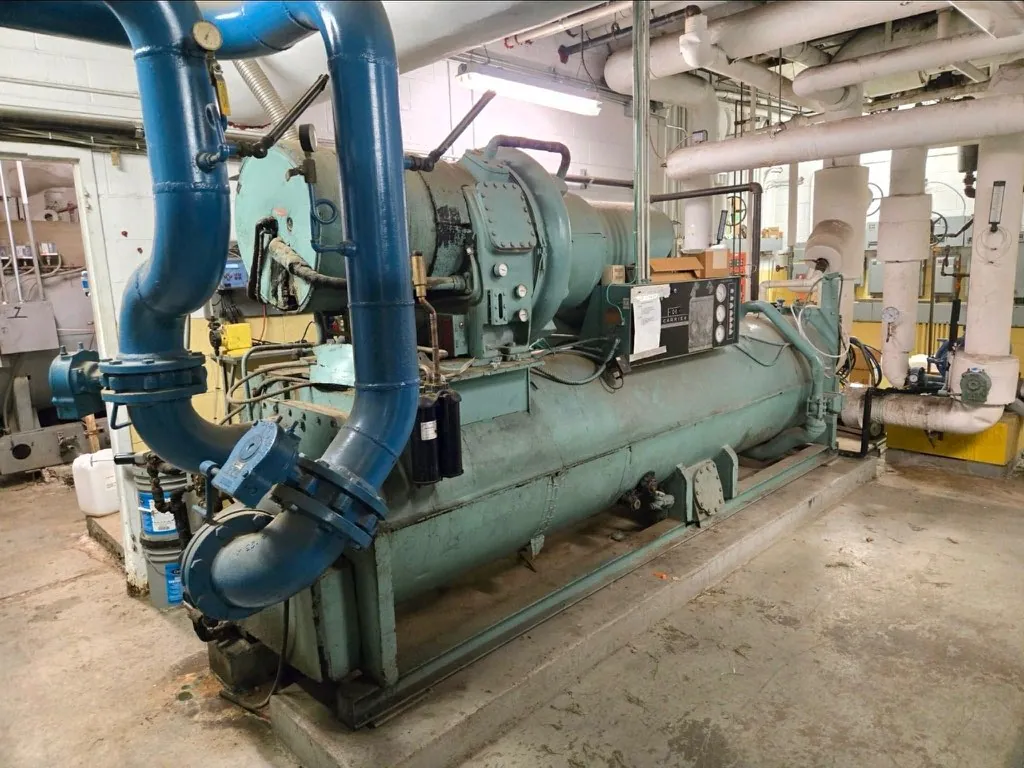
Sell a Used Chiller in Spartanburg County, SC
Sell industrial chiller equipment in Spartanburg County with upfront payment and buyer-managed logistics.
We buy chillers. We don’t sell them.
Your chiller.
Our logistics.
Have a surplus or decommissioned chiller? We’re the buyer—here to make moving it straightforward.
From a single unit to equipment from a larger facility, tell us what you have. We buy industrial and commercial chillers across South Carolina and coordinate the work to get them moved.
See how it works
All types & sizes
Air-cooled or water-cooled, centrifugal, screw or scroll. Tell us what you have.
We handle the logistics
We coordinate rigging, refrigerant recovery, loading and freight for the equipment we buy.
Made for sellers
Send the details and nameplate photos to start a conversation about your chiller.
Three steps.
One less chiller.
- 01
Send the details
Share what you know, along with photos of the unit and nameplate.
- 02
Get a quote
We’ll review your equipment and discuss an offer with you.
- 03
Leave the logistics to us
We coordinate removal and freight for the chillers we purchase.
Sell a Used Chiller in Spartanburg County, SC
South Carolina Chiller Buyers purchases used and surplus chillers throughout Spartanburg County, South Carolina. We buy equipment directly; we do not sell replacement chillers. Whether a machine is being retired from a plant, campus, commercial building, data center, or another setting, share its municipality or site location and the information available about it. You do not need a complete equipment history to ask for an offer.
We consider all tonnages, including units below 20 tons, with 20 to 2,000-plus tons being a common range. We also consider all brands and refrigerants. An older machine, a unit with an incomplete label, or equipment that has not operated recently may still be worth discussing. Its condition and the details of the proposed sale affect the offer and removal plan, so avoid treating an uncertain identification as confirmed.
Start With What You Can Verify
Older chillers may carry faded, painted-over, damaged, or replaced labels. A nameplate can help identify the manufacturer, model, serial number, capacity, electrical information, and refrigerant, but not every field will be legible or present. Send a clear photo if one can be taken safely from an accessible position. If a marking cannot be read, say so rather than filling in a likely value.
Retrofit records can be useful when the original nameplate no longer describes the equipment as it stands today. Past service paperwork may record a refrigerant conversion, a compressor or control change, or other work. Such documents can help explain a mismatch between old labels and present records, but they are not proof of the current configuration by themselves. Share records as available and identify which details are documented versus remembered or uncertain.
Separate the Chiller From Equipment That Stays
When a system is being retired, establish whether the sale covers one chiller or an entire bank. A machine may sit beside other units and share piping, controls, electrical gear, or a plant room. Those neighboring components should not be assumed to be included. Photos from several angles and a short description of the proposed asset can help distinguish what is for sale from shared equipment that must remain.
If the equipment boundary is unclear, describe the uncertainty before an offer is considered. For example, a site representative might identify one tagged machine as the intended sale while noting that its connections or controls are shared. That is more useful than assuming every nearby component belongs to the chiller. Do not open, disconnect, cut, or dismantle anything to clarify the boundary.
Capacity Is Not a Shipping Weight
Chiller tonnage describes cooling capacity, not the machine’s transport weight or the space and access needed to remove it. A compact unit can still be heavy, while a larger system may consist of multiple sections or associated components. If weight is not listed, do not estimate it from tonnage. Available drawings, manufacturer documents, or existing site records may help, but an unknown value should remain unknown.
Access information matters too. Describe the unit’s general position, the route to an exit, and any known constraints such as limited clearance or restricted access. You do not need to arrange a crane, rigging, freight, or a carrier. After an agreed purchase, South Carolina Chiller Buyers handles disconnects, necessary refrigerant recovery through appropriately qualified personnel, crane and rigging, loading, hauling, and freight, which is covered.
What to Send for a Useful Review
A few accurate details can make the initial review more productive. You can share whichever items are available without testing or preparing the chiller:
- Site municipality or location, and the type of setting.
- Manufacturer, model, serial number, and nameplate photos, if readable.
- Known refrigerant and any retrofit or service records, clearly identified as confirmed or uncertain.
- Whether one unit or a group is included, plus photos that show nearby equipment.
- Known condition, current status, and any access or removal constraints.
Do not energize the equipment, start it, drain it, vent refrigerant, or attempt repairs to answer questions. Sellers do not need to test, repair, or prepare a unit to request an offer. If its status is unknown, report that plainly.
Agree on Scope, Payment, and Removal
Payment is upfront after the purchase is agreed. The offer depends on the equipment and the terms of the agreement; no specific price can be promised before the details are reviewed. The removal schedule is also coordinated around the equipment and agreement, so a particular date should not be assumed in advance.
The authorized owner or site representative must provide permission for the sale and coordinate access. That role is important even when a contractor, facilities employee, or other contact supplies equipment information. Once the purchase is agreed, the buyer manages the removal work described above, including freight. The seller does not need to ship the machine or hire a removal crew.
Share Uncertainty Instead of Guessing
For a chiller in Spartanburg County, an old label, incomplete records, or a possible retrofit need not prevent an initial conversation. Identify what is visible, what paperwork supports, and what remains uncertain. That distinction helps assess the actual equipment rather than a guessed specification, and it gives both parties a clearer basis for discussing the proposed sale and removal.
Ready to move
your chiller?
Tell us what you know. If you’re unsure of a detail, leave it blank. Nameplate photos are a great place to start.

Request a quote.
Fill out what you can and we’ll be in touch.