Sell a Used Chiller in Abbeville County, SC
Sell industrial chiller equipment in Abbeville County with upfront payment and buyer-managed logistics.
We buy chillers. We don’t sell them.
Your chiller.
Our logistics.
Have a surplus or decommissioned chiller? We’re the buyer—here to make moving it straightforward.
From a single unit to equipment from a larger facility, tell us what you have. We buy industrial and commercial chillers across South Carolina and coordinate the work to get them moved.
See how it works
All types & sizes
Air-cooled or water-cooled, centrifugal, screw or scroll. Tell us what you have.
We handle the logistics
We coordinate rigging, refrigerant recovery, loading and freight for the equipment we buy.
Made for sellers
Send the details and nameplate photos to start a conversation about your chiller.
Three steps.
One less chiller.
- 01
Send the details
Share what you know, along with photos of the unit and nameplate.
- 02
Get a quote
We’ll review your equipment and discuss an offer with you.
- 03
Leave the logistics to us
We coordinate removal and freight for the chillers we purchase.
Sell a Used Chiller in Abbeville County, SC
South Carolina Chiller Buyers purchases used and surplus chillers in Abbeville County, South Carolina. We are a direct buyer, not a seller of replacement equipment. We consider chillers of every tonnage, including units below 20 tons; 20 to 2,000+ tons is a common range. All brands and refrigerants are considered.
To start, share the municipality or site location and whether your chiller is in a plant, campus, commercial building, data center, or another setting. You do not need to start, test, repair, or prepare the equipment to request an offer. A clear account of what is present is more useful than assumptions about its capacity, contents, or operating state.
Read Old Labels Carefully—and Don’t Fill in the Blanks
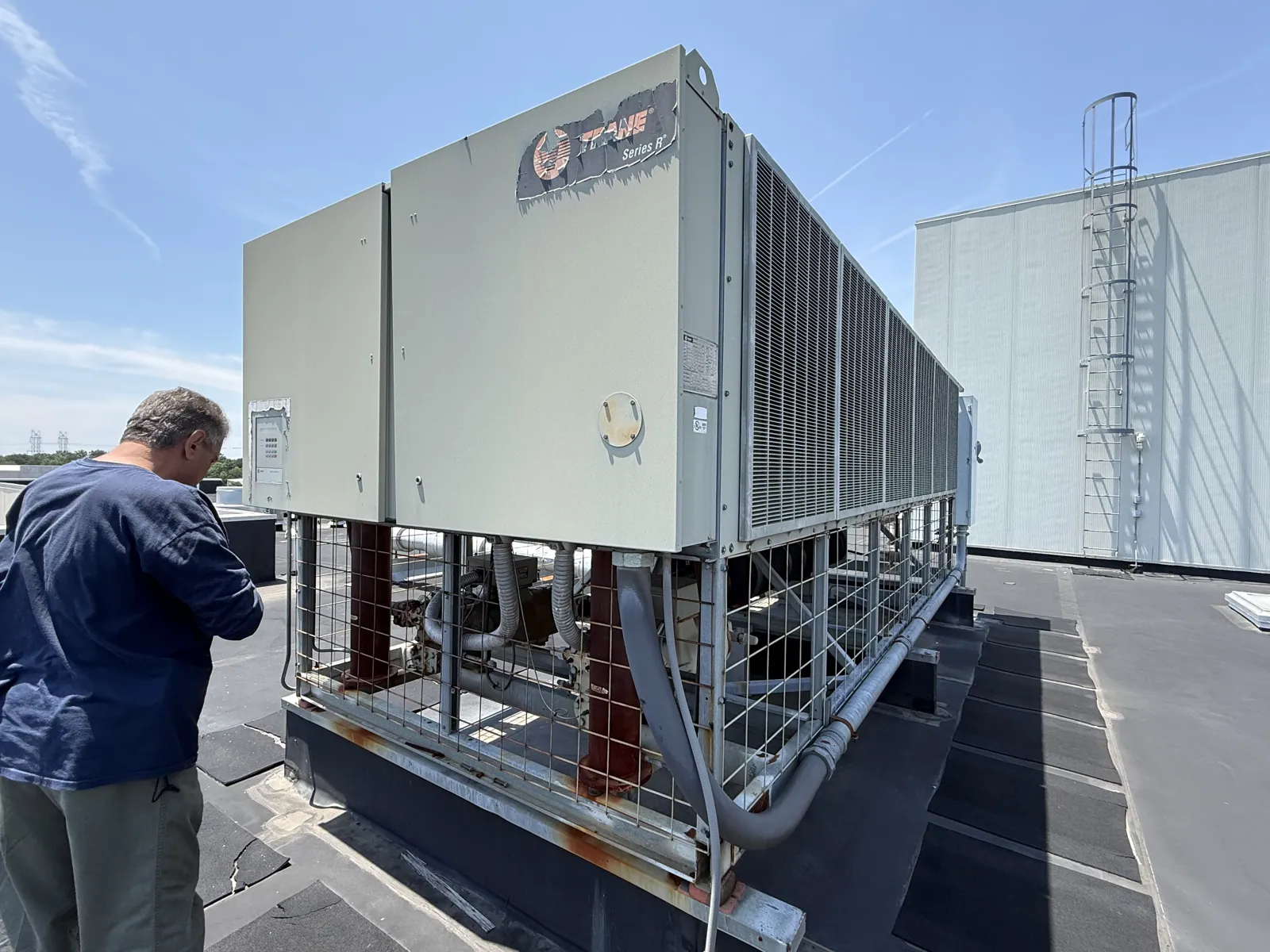
Chillers can remain in service long after a nameplate has become faded, damaged, or difficult to reach. If a label is legible from a safe, accessible position, a photo can help identify the manufacturer, model, serial number, nominal capacity, and refrigerant designation. Send only details you can actually read. If a field is missing or unclear, say so rather than reconstructing it from memory or guessing based on the unit’s size.
Older equipment may also have been modified during its working life. A nameplate can describe the original configuration, while later service or retrofit records may document a refrigerant conversion or other change. Neither source should automatically be treated as a complete description of the machine as it stands today.
Use Records as Evidence, Not as a Substitute for Identification
If available, provide maintenance notes, retrofit paperwork, equipment schedules, or prior service records alongside photographs. They may help clarify a refrigerant designation, model detail, or change in configuration. If records disagree with one another or with the visible label, point out the discrepancy. The buyer can assess the information together; you should not attempt to verify it by opening, energizing, draining, venting, cutting, or dismantling the chiller.
It is also useful to distinguish refrigerant from process fluid. Refrigerant circulates within the chiller’s refrigeration circuit; process fluid, often water or a water-based mixture, carries cooling to or from the connected system. A fluid described in plant notes may not be the refrigerant. If you do not know which is which, report the wording in the record without assigning it a role.
Define the Equipment Being Offered
When equipment in Abbeville County is being retired, establish whether the proposed sale is one chiller or an entire bank. Provide photos that show the unit and, where practical, its position relative to nearby equipment. Describe any adjoining chillers, pumps, piping, electrical gear, or shared supports that are not part of the proposed sale. This helps distinguish your chiller from equipment that must remain in service.
Capacity and transport weight are different facts. A tonnage figure describes cooling capacity, not the mass a crane or truck must handle. If a reliable weight is available in a document, share its source; do not infer weight from tonnage or try to measure it by moving the machine. Removal planning depends on the actual equipment and site conditions.
Useful Details for an Initial Review
- Site municipality or location, plus the type of setting.
- Readable nameplate information and photos, if safely accessible.
- Known retrofit or service records, with any uncertainty noted.
- Whether one unit or multiple chillers are included, and what stays.
- Known condition and access constraints, without operating or altering the equipment.
A missing nameplate does not mean you should invent a model number. Tell us what information is unavailable and describe the equipment as accurately as you can. The offer and removal schedule depend on the equipment and the agreement reached.
Purchase, Payment, and Removal Responsibilities
If we agree to purchase the chiller, payment is upfront. After the purchase is agreed, South Carolina Chiller Buyers handles disconnects, necessary refrigerant recovery through appropriately qualified personnel, crane and rigging, loading, hauling, and freight; freight is covered. Sellers do not need to hire a carrier or ship the equipment themselves.
The authorized owner or site representative must still approve the work and coordinate access. Share relevant site restrictions, access limitations, and equipment boundaries before removal planning. Do not disconnect or prepare the unit on our behalf. The exact work and timing are coordinated according to the equipment, site, and agreed terms; no particular price or removal date can be assumed before review.
Request an Offer Without Guesswork
Whether the chiller is a small standalone unit or part of a larger bank, provide the information you can verify and clearly flag what remains uncertain. In Abbeville County, that straightforward distinction—known facts versus missing or conflicting records—helps us review the asset without asking you to disturb it. Send the site location, available label details, relevant retrofit documentation, and a description of what is included to request an offer.
Ready to move
your chiller?
Tell us what you know. If you’re unsure of a detail, leave it blank. Nameplate photos are a great place to start.

Request a quote.
Fill out what you can and we’ll be in touch.