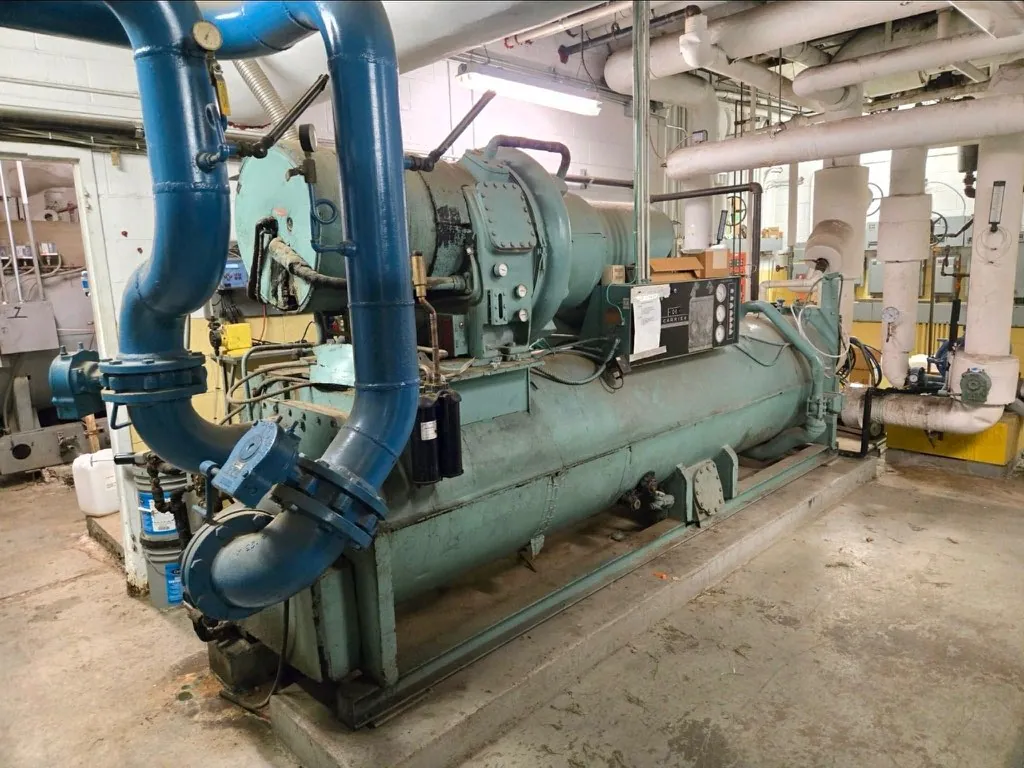
Sell a Used Chiller in Lexington County, SC
Sell industrial chiller equipment in Lexington County with upfront payment and buyer-managed logistics.
We buy chillers. We don’t sell them.
Your chiller.
Our logistics.
Have a surplus or decommissioned chiller? We’re the buyer—here to make moving it straightforward.
From a single unit to equipment from a larger facility, tell us what you have. We buy industrial and commercial chillers across South Carolina and coordinate the work to get them moved.
See how it works
All types & sizes
Air-cooled or water-cooled, centrifugal, screw or scroll. Tell us what you have.
We handle the logistics
We coordinate rigging, refrigerant recovery, loading and freight for the equipment we buy.
Made for sellers
Send the details and nameplate photos to start a conversation about your chiller.
Three steps.
One less chiller.
- 01
Send the details
Share what you know, along with photos of the unit and nameplate.
- 02
Get a quote
We’ll review your equipment and discuss an offer with you.
- 03
Leave the logistics to us
We coordinate removal and freight for the chillers we purchase.
Sell a Used Chiller in Lexington County, SC
Closing a property can leave a substantial chiller in place after the building’s future has been decided. If you are responsible for the equipment, South Carolina Chiller Buyers considers used and surplus chillers throughout Lexington County, South Carolina. We are a direct buyer, not a seller of replacement equipment. You can request an offer whether the chiller is in a plant, campus, commercial building, data center, or another setting.
A closure does not automatically mean every machine on site is available. First determine who owns the equipment and whether it is included in the sale or disposal plan. If you are a property manager, contractor, or other representative rather than the owner, confirm that you are authorized to discuss a purchase and arrange site access.
Start with the property’s disposition plan
Identify the equipment that can be sold before arranging any work around it. In a building closure, one chiller may be retired while another remains connected to a shared system, or an entire bank may be released together. The distinction affects what is being offered and how a later removal could be coordinated.
Make a simple inventory of the proposed asset or assets. Note which unit is available, which equipment must remain, and whether there are restrictions on access or timing. If the property is being transferred, check that the person handling the chiller has permission to sell it and that the agreed removal will not conflict with the transaction or site requirements.
Share enough information to identify the machine
For an initial review, provide the municipality or site location within Lexington County, the number of chillers under consideration, and any available nameplate information. Photos can help distinguish the unit from nearby equipment and show its general condition and surroundings. A short description of what is known—such as whether it is operating, idle, or awaiting retirement—is useful, but you do not need to start or test it to request an offer.
If records are incomplete, share what you have and identify what is uncertain. Do not open panels or disturb the chiller to find missing details. The unit’s rated capacity is also not its transport weight: tonnage describes cooling capacity, while the weight and dimensions relevant to removal depend on the equipment itself and the handling plan.
Capacity, condition, and sale scope
South Carolina Chiller Buyers considers all tonnages, including units below 20 tons; 20 to 2,000+ tons is a common range. We consider all brands and all refrigerants. A small chiller is not automatically outside the scope, and a large rating alone does not determine an offer. The equipment, its condition, its location, the agreed sale scope, and removal requirements all matter.
Clarify whether the proposed sale is for one chiller or multiple units, and avoid including shared equipment that must stay with the property. If a unit is incomplete or its operating history is unknown, describe that accurately rather than arranging repairs or a test run. Any offer and removal schedule depend on the equipment and the agreement; neither a particular price nor a specific date should be assumed before review.
Keep refrigerant and process fluid distinct
A chiller may involve refrigerant in its refrigeration circuit and a separate process fluid or water loop used to carry cooling through the building. Those are different systems. Do not drain, vent, cut, dismantle, or otherwise alter the machine as a way to prepare it for sale. If refrigerant recovery is necessary, it is handled after an agreed purchase by appropriately qualified personnel as part of the buyer’s removal work.
This distinction is especially useful when site records describe a system as “drained” or “empty.” Such wording may refer to a water or process-fluid loop, not the refrigerant circuit. Share the records or your understanding, and leave the equipment untouched pending the agreed plan.
What happens after an agreement
After a purchase is agreed, the buyer handles disconnects, any necessary refrigerant recovery through appropriately qualified personnel, crane and rigging, loading, hauling, and freight. Freight is covered. Sellers do not need to test, start, repair, or prepare the chiller before asking for an offer, and they do not need to hire a carrier or ship the equipment themselves.
The authorized owner or site representative still needs to provide permission and coordinate access. For a closing property, that may mean confirming entry arrangements, site contacts, and any limits on when work can occur. The removal plan and timing are established around the equipment and the agreement, not assumed in advance.
A practical checklist for a closure
- Confirm ownership and authority to sell.
- Define whether one chiller or an entire bank is available.
- Share the site location, nameplate details if available, photos, and known condition.
- Identify equipment that must remain and coordinate site access.
- Leave testing, repair, draining, and dismantling out of the request process.
With those details, you can request an offer for your chiller in Lexington County without taking on removal work or making unsupported assumptions about value or timing.
Ready to move
your chiller?
Tell us what you know. If you’re unsure of a detail, leave it blank. Nameplate photos are a great place to start.

Request a quote.
Fill out what you can and we’ll be in touch.